How Long Are Limos? A Guide to Vehicle Lengths & Sizes
You’re probably asking a simple question with a not-so-simple answer. You need transportation for an airport pickup, a wedding, or a corporate group, and you want to know how long are limos before you book the wrong vehicle and create a problem at the curb, the venue gate, or the hotel entrance.
That’s the right way to think about it.
Many clients start with passenger count. Fleet managers and experienced planners start with route, access, and stopping conditions. A vehicle can look perfect on paper and still be the wrong choice if it can’t make a clean turn at the terminal, fit the arrival lane, or get up a private drive without awkward staging.
In Southern California, length matters more than many booking guides admit. The vehicle that works best for a polished airport transfer often isn’t the one that works best for a winery tour. The vehicle that photographs well at a wedding may be the one that creates the most headaches at the venue.
Why Limo Length is More Than Just a Number
A common booking scenario goes like this. An executive assistant needs transportation for a small VIP group flying into Los Angeles, then heading to a client dinner, then to a hotel with a tight porte-cochère. The first instinct is often to book the longest, most impressive vehicle available.
That’s where problems start.
A longer vehicle changes the whole job. It affects the pickup plan, where the chauffeur can wait, whether the vehicle can pull through without backing up, and how easily passengers can step in and out without holding up traffic. For some occasions, a classic stretch is still the right call. For many others, a shorter luxury SUV or Sprinter is the smoother choice.
That’s also why the conversation shouldn’t begin with luxury alone. It should begin with what has to go right on the day of service.
What planners usually overlook
Three questions matter more than typically expected:
- Where is the pickup happening: Airport curbs, hotel drives, private estates, and downtown restaurants all handle long vehicles differently.
- How many stops are involved: One direct run is easier than a multi-stop itinerary with tight turns and loading zones.
- What kind of arrival matters most: Some events call for a statement vehicle. Others call for speed, easy entry, and zero friction.
The best vehicle isn’t the one that looks largest online. It’s the one that fits the itinerary without forcing workarounds.
For special occasions, the right limo still has a clear place. If you want a style-first arrival for a celebration, this breakdown of why a limo is perfect for special occasions is useful. But once logistics get complicated, length becomes an operating issue, not just a style choice.
A Visual Guide to Chauffeured Vehicle Lengths and Capacities
Vehicle categories are fairly standardized, which helps when you’re comparing options. Traditional luxury sedans, stretches, SUV limousines, Sprinters, and mini-coaches each solve a different transportation problem.
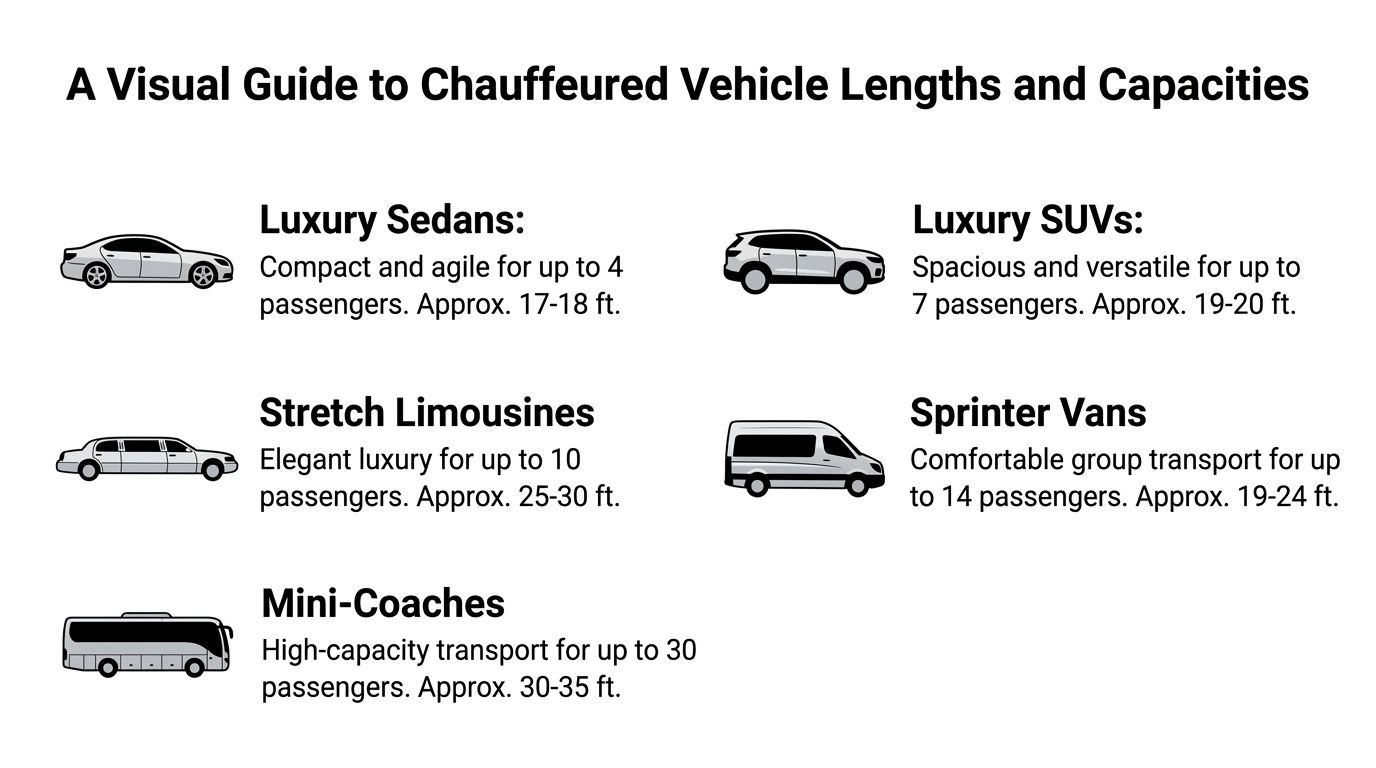
Typical length ranges by vehicle class
According to this overview of standard limousine lengths by vehicle type, luxury sedan limousines typically measure 18 to 22 feet and accommodate 2 to 3 passengers, stretch limousines generally range from 25 to 35 feet for 8 to 12 passengers, and stretch SUV limousines extend 28 to 38 feet for 14 to 20 passengers. The same source notes that extreme custom builds can go far beyond that, including the 60-foot American Dream.
That gives you the broad market picture. In real chauffeured service planning, the useful question is what each size does well.
| Chauffeured Vehicle Fleet Comparison | Typical Length (Feet) | Passenger Capacity | Best For |
|---|---|---|---|
| Luxury Sedan | 18-22 | 2-3 | Executive travel, airport transfers, single-couple service |
| Executive SUV | Similar practical class to sedan-based executive service, often chosen when more luggage or easier ingress matters | Small groups | Airport runs, hotel transfers, client hosting |
| Stretch Limousine | 25-35 | 8-12 | Weddings, proms, milestone celebrations |
| Stretch SUV Limousine | 28-38 | 14-20 | Larger celebratory groups, nightlife, event arrivals |
| Sprinter Van | Commonly selected for group ground transport when flexibility matters | Group service | Airport groups, corporate roadshows, winery outings |
| Grech Mini-Coach | Full group transport class | Larger groups | Events, shuttles, conferences, venue loops |
What works best in practice
Length and capacity don’t tell the whole story. Use case matters.
A sedan works when timing is tight and curb access is the priority. It’s easy to load, easy to route, and rarely raises access concerns.
A stretch limousine works when the ride itself is part of the event. Bridal parties, anniversaries, and formal arrivals still fit that format well.
A Sprinter or mini-coach solves a different problem. It keeps a group together, gives better boarding flow, and usually makes more sense when the itinerary includes luggage, airport loading, or repeated stops.
A quick decision filter
If you’re comparing categories, use this simple filter:
- Choose a sedan when the trip is point-to-point and image needs are executive rather than ceremonial.
- Choose a stretch limo when the vehicle is part of the experience and the route is manageable.
- Choose a Sprinter or mini-coach when group coordination matters more than old-school limo styling.
For a side-by-side look at modern service options, the current fleet view is the easiest place to compare body styles and trip fit.
Practical rule: Capacity gets people in the vehicle. Length determines whether the vehicle works at the property.
How Vehicle Length Impacts Maneuverability and Parking
A long vehicle doesn’t just take up more space. It moves differently.
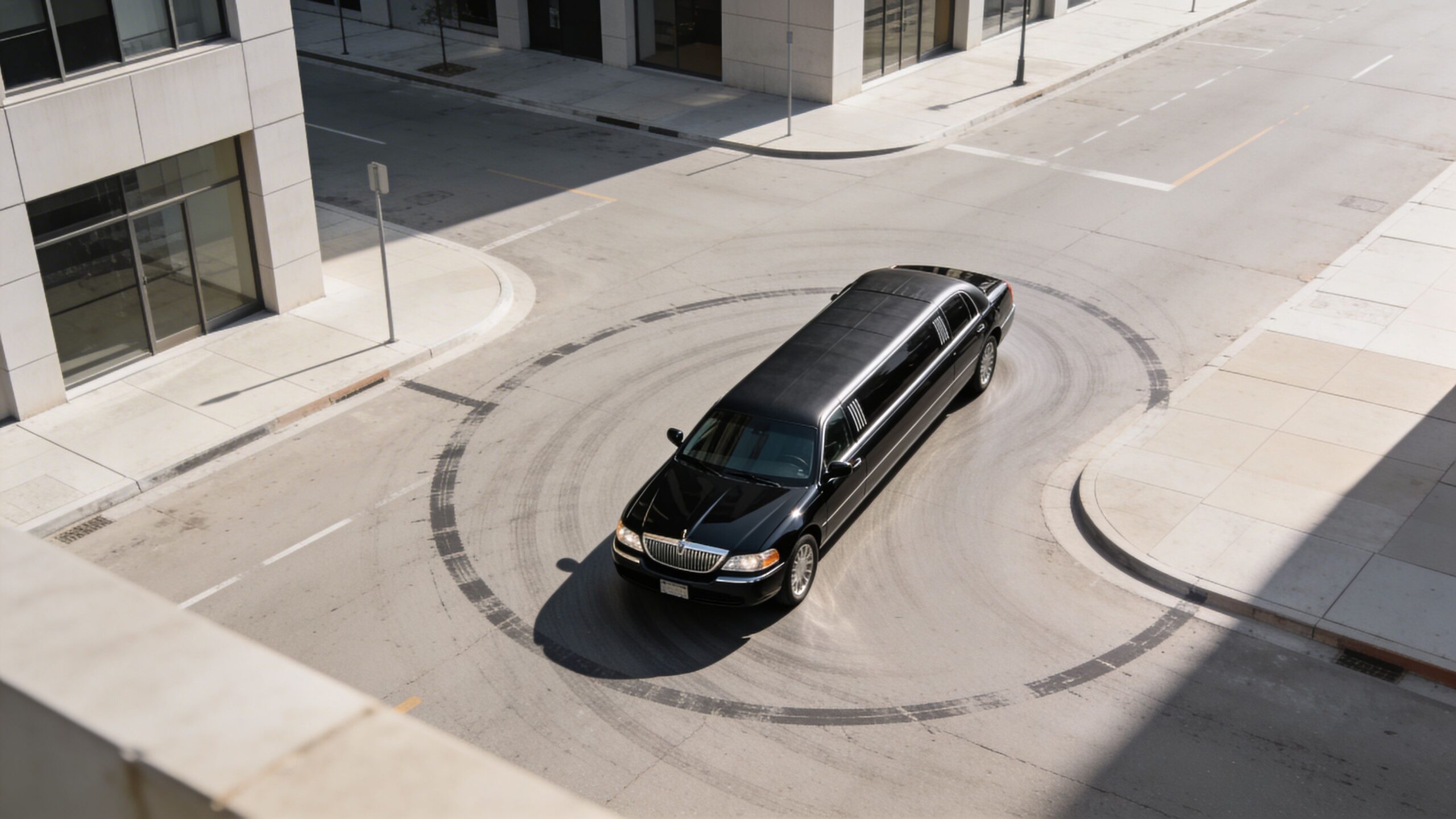
The biggest operational change is turning radius. A vehicle can have enough seats and still be a poor fit if the itinerary includes downtown blocks, valet queues, loading docks, or narrow hotel entrances.
Turning radius changes the whole route
This summary on stretch limo maneuverability and stability notes that stretch limousines, typically 25 to 35 feet long, have turning radii of 45 to 50 feet, compared to 35 to 40 feet for standard sedans. That same source also notes that lengths beyond 35 feet can trigger federal DOT scrutiny for stability because the center of gravity shifts and reinforced framing becomes more important.
Those numbers show up immediately in real driving conditions.
A longer wheelbase means wider turns, more care at intersections, and less forgiveness in garages and circular drives. A chauffeur may need to approach the same entrance from a different direction just to line up the turn cleanly. In dense urban pockets, that can determine whether the arrival feels smooth or clumsy.
Where long vehicles struggle
The toughest locations usually include:
- Downtown curb lanes: Traffic pressure leaves little room for a second attempt.
- Hotel motor courts: Decorative layouts often look generous but pinch at the turn-in.
- Private venues: Gates, landscaping islands, and parked guest cars remove the margin for error.
- Parking structures: Height is one issue, but ramp angle and turning room are often the primary problem.
A skilled chauffeur solves part of this. Good dispatch planning solves the rest.
If your route includes city traffic and multiple stops, a guide to efficient city travel with car service in San Diego gives a useful lens on why route design matters as much as vehicle class.
A short demonstration makes the point better than any description:
Parking isn’t just a convenience issue
Parking affects timing, guest flow, and driver staging. A long vehicle may need a different waiting area, a larger loading zone, or a cleaner approach path than the client expects. That’s why smart planning always includes the physical property, not just the address.
Navigating Airport Pickups at LAX SAN and SNA
Airport pickups are where length mistakes become obvious fast.
A lot of travelers assume the biggest luxury vehicle is the safest booking choice for a group. At airports, that’s often backwards. The better choice is usually the vehicle that can enter, stage, load, and exit without friction.
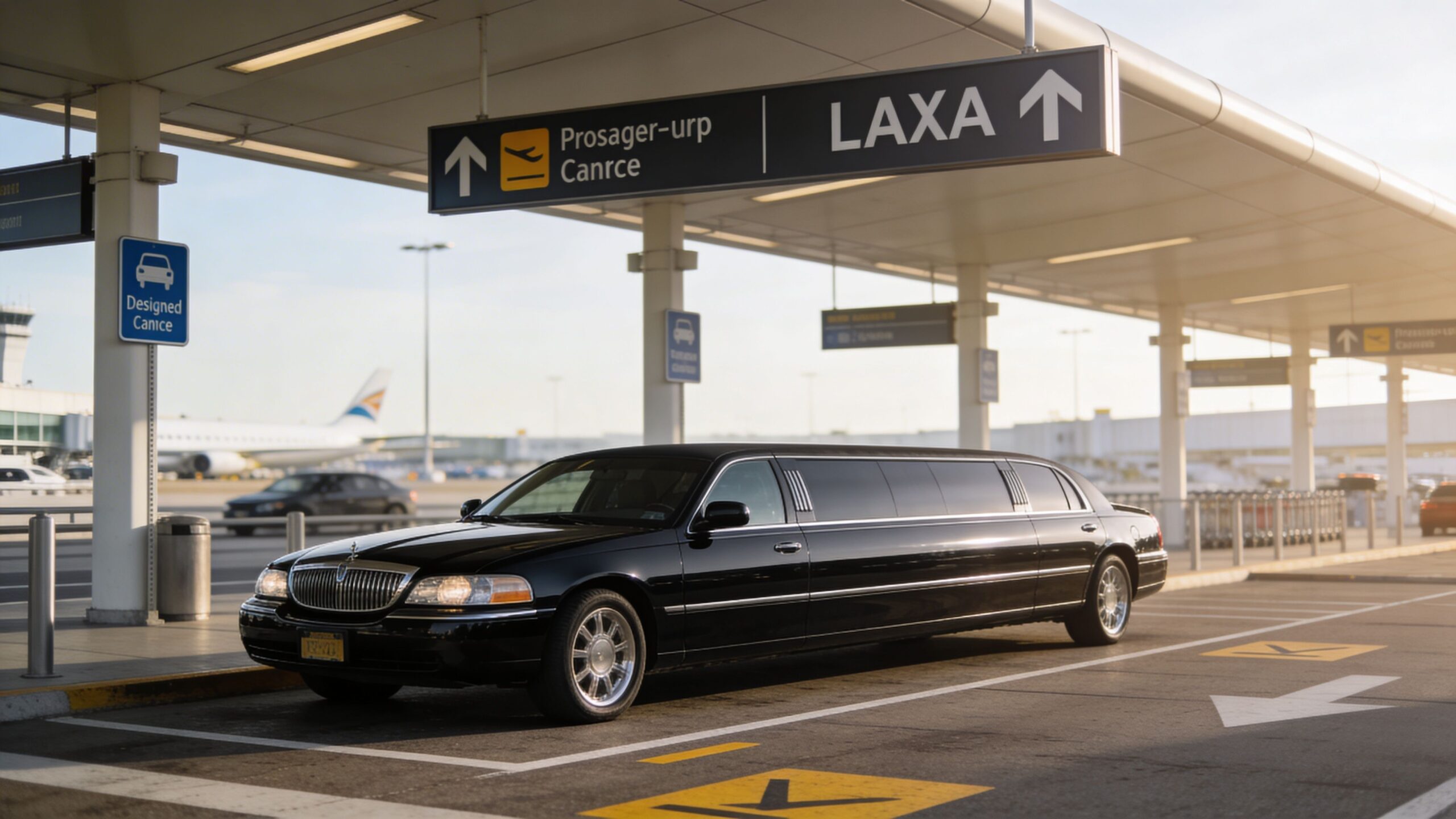
Why airport curbs punish oversized vehicles
This overview of Southern California airport limo length restrictions highlights a point many generic guides skip: LAX often rejects vehicles over 30 feet from direct terminal access, which can force off-site staging. The same source notes that this creates delay risk for travelers who book oversized vehicles, and it points to Mercedes Sprinters, typically 24 to 33 feet, as a more reliable airport-compliant option.
That issue isn’t theoretical.
At a busy terminal, every part of the pickup is compressed. The chauffeur has to enter at the right moment, reach the right zone, load passengers quickly, and clear the curb. If the vehicle is too long for the flow pattern or holding area, the job gets harder even before passengers walk out of the terminal.
What usually works best by airport style
LAX rewards operational simplicity. Vehicles that can move through active terminal traffic without special handling usually produce the cleanest pickups.
SAN has a more compressed feel. Terminal circulation can tighten quickly, especially when several arrivals hit at once. A vehicle that boards fast and leaves fast usually wins.
SNA tends to favor order and pace over showmanship. That makes practical executive vehicles and right-sized group vehicles a strong fit.
For airport work, the smoothest vehicle is usually the one that spends the least time fighting the curb environment.
A better way to book airport transportation
For airport transfers, ask these questions before choosing a vehicle:
- Is this a direct pickup or meet-and-greet style arrival
- How much luggage is coming with the group
- Will everyone arrive on the same flight
- Does the airport approach matter more than the onboard celebration feel
If punctuality matters more than presentation, shorter executive vehicles and airport-friendly Sprinters usually outperform long novelty-oriented stretches.
For travelers comparing pickup formats, terminal logistics, and airport-specific planning, this airport transfer guide for SAN and LAX pickups is the right reference point.
Matching Vehicle Length to Your Wedding or Event Venue
Wedding and event transportation fails most often at the property line.
A vehicle can be perfect for the guest count and still create a bad arrival if the driveway is steep, the gate is narrow, or the drop-off loop can’t handle the turn. That’s why venue access should be checked before anyone falls in love with a specific vehicle style.
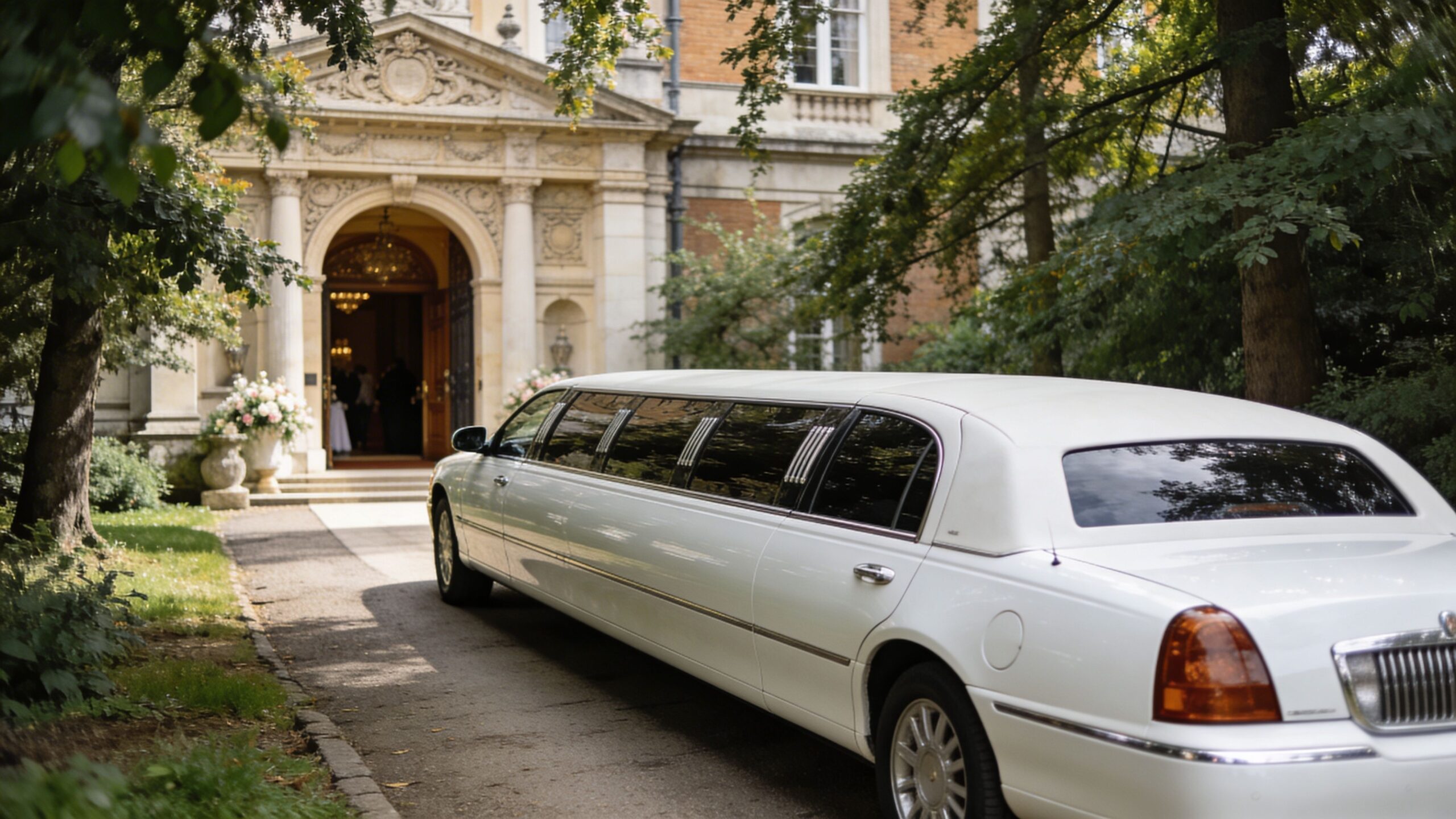
Wineries, estates, and older venues change the answer
This analysis of SUV stretch limousines and Sprinter length for venue access notes that SUV-based stretch limousines and Mercedes Sprinters range from 28 to 40 feet and support 12 to 22 passengers with greater headroom. It also points out a critical venue constraint: gated drives in places like Rancho Santa Fe may not accommodate vehicles over 25 to 30 feet, making shorter-wheelbase Sprinters or Grech mini-coaches a safer fit.
That lines up with what planners run into across Southern California.
Temecula winery routes can be easy on the highway and awkward at the final approach. Private estates often look expansive in photos but narrow sharply at the gate or motor court. Historic buildings may have beautiful frontage and surprisingly unforgiving access.
A venue-first booking mindset
Before choosing a vehicle, confirm:
- Gate width and driveway geometry: A long body needs room before it needs luxury features.
- Final approach surface: Tight turns, hills, and decorative curbs matter.
- Drop-off pattern: Some venues work better with shuttle-style loading than a single oversized vehicle.
- Guest movement: If guests board at different times, a flexible group vehicle often works better than a ceremonial stretch.
For planners comparing intimate properties, resources on small wedding venues can be helpful because smaller sites often share the same access issue regardless of city: charm usually comes with tighter approach conditions.
A wedding vehicle should enhance the arrival, not force guests to walk from the street because the driveway can’t handle the turn.
What usually works
A classic stretch still fits venues with a clear arrival lane and a simple loop. It photographs well and creates a formal moment.
A shorter Sprinter or mini-coach often wins when the event needs to move people reliably between hotel blocks, ceremony sites, and reception spaces. It’s less dramatic, but it’s often the reason the schedule stays intact.
How to Book the Right Size Vehicle Every Time
The easiest way to avoid a vehicle mismatch is to give the transportation provider better operating information. Most bad bookings happen because the client shares the event type but not the physical constraints.
The industry itself has already moved toward practicality. According to the limousine industry overview on Wikipedia, traditional stretch limousines have seen a 90% reduction in market share over the past decade and now comprise only one percent of offerings, reflecting stronger demand for more versatile vehicles such as SUVs and Sprinter vans.
That shift makes sense. Clients still want luxury, but they also want vehicles that load cleanly, move efficiently, and fit modern travel patterns.
The booking details that matter most
Use this checklist before you confirm any reservation:
Passenger count
Give the actual count, not the optimistic one. If there are children, assistants, or last-minute additions, say so early.
Luggage profile
Airport groups often fit by seats and fail by baggage. A group with checked luggage needs a different vehicle plan than the same group traveling light.
Full itinerary
Include every pickup, stop, wait, and drop-off. A single hotel run is one thing. A dinner stop, venue transfer, and late-night return is another.
Exact addresses
Venue names aren’t enough. The actual entrance, service gate, hotel wing, or terminal matters.
Access questions worth asking yourself
Some of the most useful details come from the client side:
- Is there a gate or steep driveway
- Does the venue have a circular drive or just a curb
- Will guests board in waves
- Does anyone need easy step-in height or extra aisle room
The fastest way to get the right recommendation
Send the transportation company the facts they need up front:
- Headcount and luggage
- Addresses for every stop
- Event type and timing
- Any access concern you already know about
If you want a clean list of what to prepare, this car service booking checklist is a practical starting point.
The best bookings happen when clients describe the route like an operation, not just the event like a celebration.
Conclusion The Smart Way to Think About Limo Length
When people ask how long are limos, they’re usually asking about size. The better question is whether that size works for the trip.
A limo’s length affects curb access, turning room, parking options, loading speed, route planning, and venue compatibility. For some jobs, a classic stretch is exactly right. For others, a sedan, SUV, Sprinter, or mini-coach does the work better because it fits the environment with less effort.
That’s the actual decision standard. Not “What’s the fanciest option?” but “What will run cleanly from first pickup to final drop-off?”
In Southern California, that distinction matters. Airports move fast. Hotel entrances can tighten unexpectedly. Wineries, private estates, and event venues often look easier to access than they really are. The right vehicle length prevents awkward arrivals, off-site staging, long guest walks, and schedule drift.
Smart planners treat vehicle selection like logistics. That’s how you protect the guest experience.
If you want help matching the right vehicle to your airport transfer, wedding, corporate itinerary, or group event, contact Rides On Time Transportation. Their team knows Southern California airport procedures, venue access realities, and the practical trade-offs between sedans, SUVs, Sprinters, and mini-coaches, so you can book with confidence instead of guessing.