You land at LAX, clear the terminal, and hit the familiar decision point. Do you open a rideshare app, join a shuttle queue, or step into a pre-arranged car waiting on a live flight update?
That choice looks simple until the airport is crowded, your meeting clock is running, your family is tired, or your client is texting from baggage claim. At LAX, the cheapest visible option is not always the lowest-cost option once you factor in delay risk, pickup friction, baggage handling, and the cost of a failed handoff.
A good lax airport car service decision comes down to one question. What failure can you afford today? If the answer is “not much,” then the comparison has to go beyond the fare shown on a screen.
Navigating the LAX Ground Transportation Maze
Most travelers do not struggle with the drive itself. They struggle with the handoff.
At LAX, the handoff is where plans break. A traveler exits baggage claim, sees multiple pickup signs, gets conflicting app directions, and starts moving before they know which system they are using. By that point, every wrong turn feels expensive.
This is why LAX confuses even frequent flyers. Traffic recovery and passenger recovery have not moved in lockstep. As of August 2024, LAX peak-hour vehicle traffic was still 18% below 2019 levels, while passenger screening sat at 80 to 85% of 2019 peak levels, according to the LAX 2024 Traffic Generation Report. In plain terms, the road count is lower than before, but pickup areas can still feel worse because the friction is concentrated where people transfer.
That mismatch matters for anyone booking airport transportation. A terminal can feel jammed even when the wider traffic picture says the airport has not fully returned to pre-pandemic volume. If your transportation plan depends on improvisation, you feel that bottleneck immediately.
Where stress starts
It usually starts with one of these moments:
- Arrival uncertainty: Your flight lands early or late, and your ride arrangement cannot adapt cleanly.
- Pickup confusion: You are told to move to a different zone, lot, or shuttle point after you already have luggage in hand.
- Communication gaps: The driver, dispatcher, and passenger are all operating with different information.
- Mismatch of service type: You booked a low-cost option for a high-stakes trip.
For travelers moving between Southern California airports and cities, a practical reference like this airport transfer guide for SAN and LAX pickups in 2026 helps clarify the pickup logic before the travel day, not after something goes sideways.
Tip: At LAX, the best transportation choice is often the one that reduces handoff decisions after landing.
The smart approach is not to ask, “What costs less?” first. Ask, “What creates the fewest failure points between baggage claim and the vehicle?”
Your Three Main LAX Transportation Choices
Most travelers compare the wrong things. They compare one fare quote against another, when they should first compare service models.
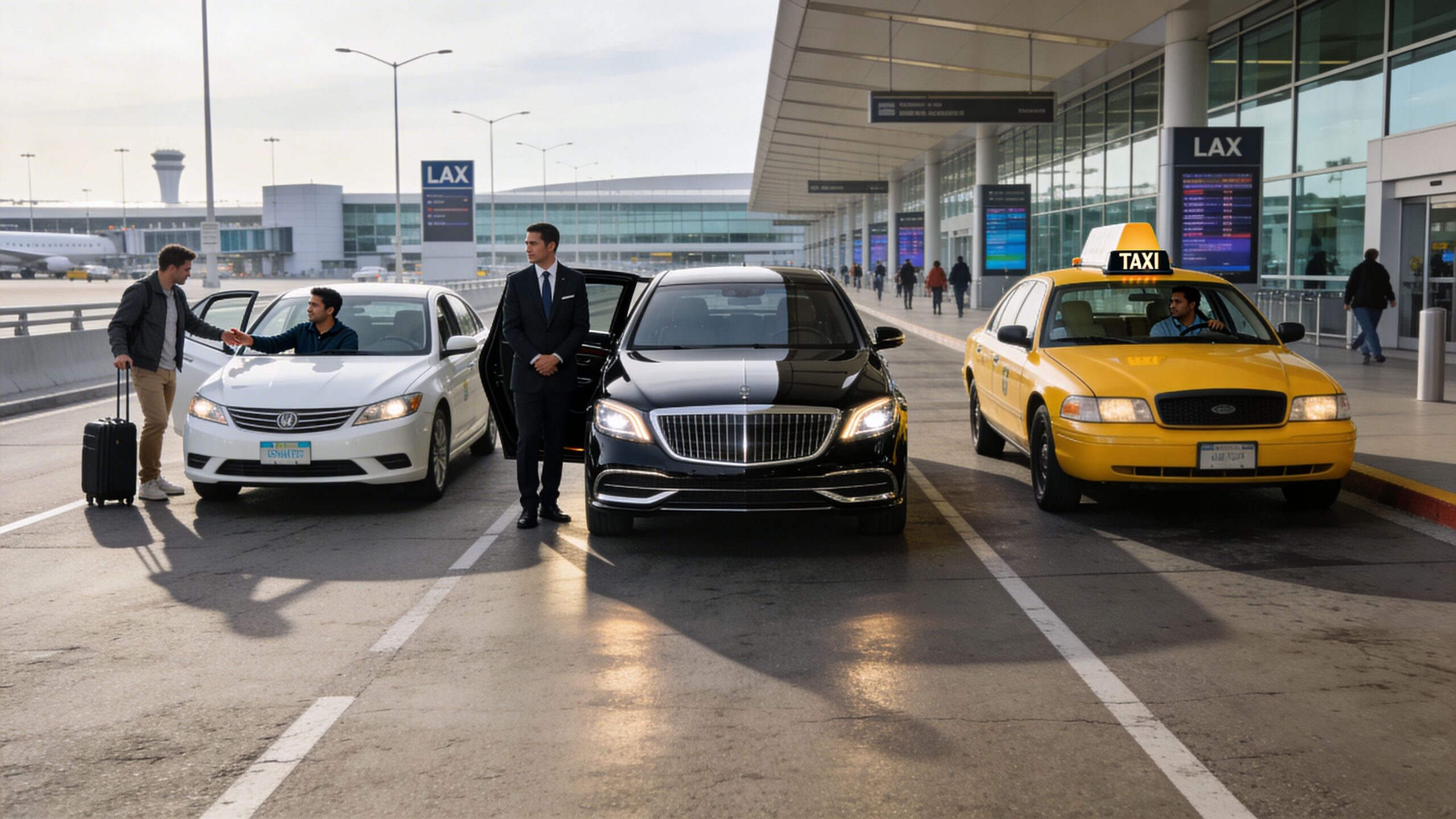
At LAX, the three main categories are professional black car service, rideshare, and shared-ride shuttle. Each solves a different problem. Trouble starts when a traveler picks one designed for another use case.
Professional black car service
This is the pre-booked, managed option.
A black car service is built around scheduling, dispatch, and accountability. The traveler books in advance, the company assigns a vehicle class, and the trip is handled through a dispatch structure rather than a one-off app match. This is usually the right fit for executives, families with a lot of luggage, VIP guests, and anyone who needs a more controlled arrival.
What works well here is predictability. The traveler knows the vehicle type, the provider knows the itinerary, and the service is built to absorb flight changes and pickup complexity. That matters at an airport where cargo-related trucks make up nearly 30% of total vehicle flow during peak hours, and where LAX processed over 2.29 million tons of cargo in 2025, as noted in this LAX airport cargo and traffic analysis. Ground transport is not moving through passenger traffic alone.
Rideshare
Rideshare is the flexible, on-demand option.
It works best when the traveler values immediacy over control and can tolerate some variation in pickup timing, vehicle type, and routing. For a solo traveler with light luggage and schedule flexibility, that trade-off can be acceptable.
The weakness is that rideshare is transactional. You are not buying a managed transportation program. You are requesting an available driver in a busy operating environment. That can work fine. It can also break down fast when the airport is crowded, the pickup flow changes, or your trip has any consequence beyond getting from point A to point B.
Shared-ride shuttle
This is the cost-focused option.
A shared shuttle is designed to spread vehicle cost across multiple passengers. It appeals to leisure travelers, students, and groups who care most about lowering the visible transportation expense.
The trade-off is simple. You save money by giving up speed, privacy, and route control. Shared stops, waiting for other passengers, and less flexibility are part of the model, not service failures.
For travelers comparing private and communal transfer styles more directly, this breakdown of the benefits of private vs shared shuttle services for San Diego to LAX transfers is useful because it frames the decision around actual trip conditions rather than generic preference.
Key takeaway: If the trip is time-sensitive, high-visibility, or operationally important, choose the model built for control, not the one built for availability.
Detailed Comparison of LAX Car Service Options
The right lax airport car service choice gets clearer once you compare by operating criteria, not brand slogans.
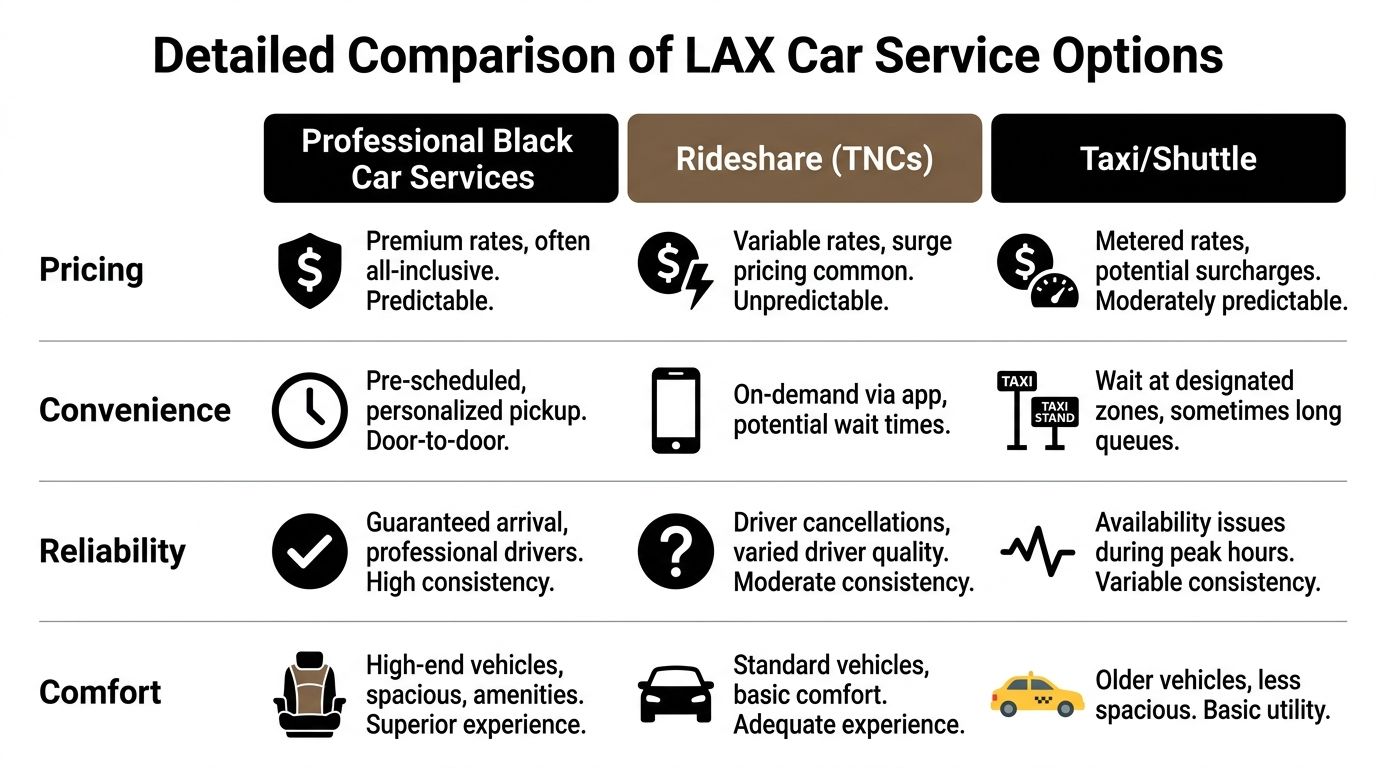
LAX Car Service Comparison At-a-Glance
| Feature | Professional Car Service | Rideshare (Uber/Lyft) | Shared-Ride Shuttle |
|---|---|---|---|
| Booking model | Reserved in advance | On-demand app request | Pre-booked or scheduled shared service |
| Pricing structure | Fixed-rate, typically quoted upfront | Variable, demand-based | Lower visible fare, shared cost |
| Pickup workflow | Coordinated pickup, often with direct communication | App-directed pickup workflow | Designated loading area, group boarding |
| Vehicle consistency | Assigned class is usually known in advance | Vehicle type can vary by availability | Utility-focused vans or shuttle vehicles |
| Luggage handling | Driver assistance is commonly part of service | Varies by driver | Limited, depends on shuttle format |
| Privacy | Private ride | Private ride, but less controlled experience | Shared with other passengers |
| Best use case | Business travel, VIPs, families, tight schedules | Flexible solo or casual travel | Budget-first travel with schedule flexibility |
| Main trade-off | Higher base price | Price volatility and pickup friction | Longer trip time and less control |
Pricing model and budget control
Pricing is the first place people get misled.
Professional LAX car services typically use fixed-rate pricing, while rideshare pricing is dynamic. During peak periods, rideshare surge pricing can raise costs by 2 to 3 times, according to this comparison of LAX car service and ride-sharing pricing models. For a corporate travel manager, that difference is not just financial. It affects budget forecasting, traveler confidence, and reimbursement friction.
A fixed quote does not automatically mean lower cost. It means the traveler and the payer know the exposure before the ride starts. That matters more than many procurement teams admit.
Shared shuttles often win the sticker-price comparison. They rarely win the total trip-efficiency comparison. If the traveler is billing time, traveling with clients, or moving on a tight schedule, the low fare can become the most expensive decision on the page.
Pickup workflow and arrival friction
Service categories separate quickly here.
A professional car service is built around a handoff. The provider knows the itinerary, watches for arrival changes, and keeps communication open between passenger, driver, and dispatch. That lowers the number of decisions the traveler has to make after landing.
Rideshare asks more of the passenger. The user has to request, locate, confirm, and adapt. None of that is bad. It is labor shifted from the transportation company to the traveler.
Shared shuttles ask for the most patience. You are joining a system that prioritizes pooled efficiency over your individual schedule.
Practical rule: If the passenger is elderly, traveling with children, carrying presentation materials, or meeting a client, reduce pickup friction first and worry about fare differences second.
Vehicle quality and fit for the trip
Vehicle class matters more at LAX than many buyers expect.
The issue is not luxury for its own sake. It is fit. The wrong vehicle creates baggage overflow, cramped seating, awkward loading, and delays at the curb. A well-run car service lets the booker choose the right asset for the trip, whether that means a sedan for one executive or a larger vehicle for a team with luggage.
That is where fleet depth matters. A provider with sedans, SUVs, and larger group vehicles can match the trip rather than forcing the trip to fit whatever happens to be available. This overview of fleet diversity in San Diego is useful because the same logic applies to LAX transfers. Vehicle selection is an operations decision, not a cosmetic one.
Rideshare can work well when your luggage load is light and your expectations are basic. It works less well when precision matters. Shared shuttles are even more constrained because utility, not customization, drives the equipment choice.
Reliability and what causes failure
Travelers often define reliability too narrowly. They think it means “did the car show up?”
At LAX, reliability includes four separate questions:
- Did the provider track flight changes?
- Did someone communicate clearly when conditions changed?
- Was the pickup plan easy to execute after baggage claim?
- Did the vehicle fit the passenger and luggage without improvisation?
Professional services tend to perform better here because the operating model includes dispatch oversight. Rideshare can still work, but its reliability depends heavily on moment-to-moment marketplace conditions. Shared shuttle reliability is different again. The vehicle may run exactly as scheduled while still being a poor fit for a traveler on a compressed timeline.
Safety, compliance, and accountability
Experienced travel managers stop shopping by fare alone when considering safety, compliance, and accountability.
A professional chauffeured service typically operates with commercial insurance, formal driver vetting, scheduled maintenance, and a dispatch layer that can intervene when something goes wrong. That creates accountability. There is a company behind the trip, not just an app interface.
For leisure travel, some passengers may accept looser standards. For executive travel, unaccompanied minors, client hosting, or high-visibility event movements, that is usually a mistake. Duty of care is not theoretical once your traveler is stranded, late, or mismatched to the pickup plan.
What works and what does not
For most LAX users, the decision can be simplified.
Professional car service works best when:
- Time has financial value: Meetings, events, connections, and pickups with little room for delay.
- The traveler needs support: Families, elderly passengers, VIPs, and corporate guests.
- The booker needs control: Vehicle class, communication, billing, and accountability matter.
Rideshare works best when:
- Flexibility is high: The traveler can absorb waiting, walking, and changing pickup instructions.
- The passenger load is light: One traveler, minimal luggage, low consequence if plans slip.
Shared shuttle works best when:
- Lowest visible price is the priority: The traveler accepts longer trip time in exchange for lower upfront cost.
- Privacy and schedule control do not matter much: Common for some leisure trips.
The mistake is not choosing a cheaper option. The mistake is choosing a cheaper model for a trip that cannot tolerate cheap-model failure.
The True Cost of Your LAX Ride in 2026
Most transportation comparisons stop at the quote. That is not enough for LAX in 2026.
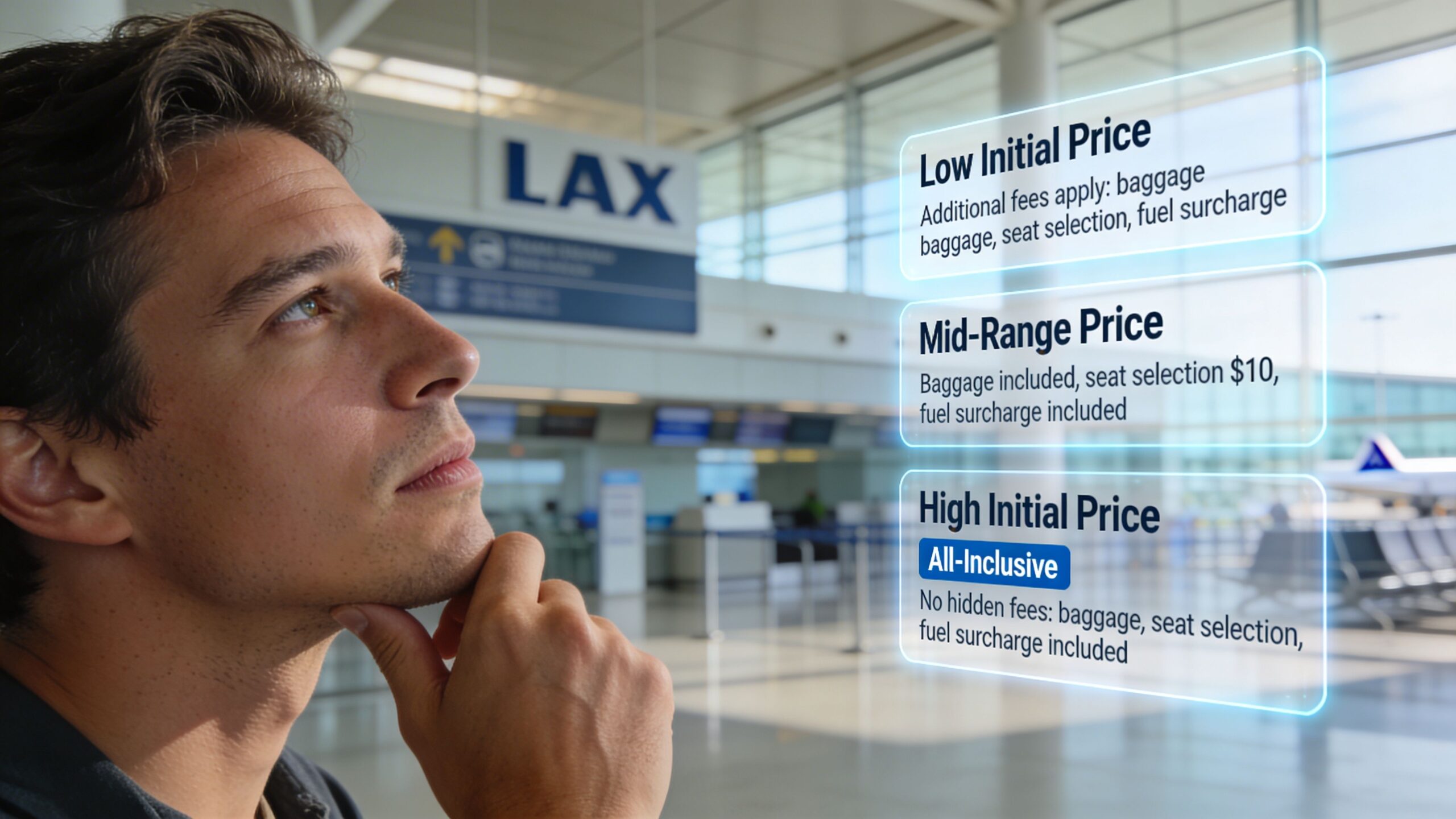
Pricing is changing because airport access itself is becoming more expensive. A 2026 proposal would raise ride-app access fees to as much as $12 for some pickups, and those fees would also apply to black car and limousine services, according to the Los Angeles Times report on the proposed LAX access-fee changes. That means every provider category will have to decide whether to absorb the fee, itemize it, or pass it through.
The visible fare is only one line item
When buyers focus only on base fare, they miss three real cost centers.
First, there is price volatility. A rideshare quote can look attractive until demand changes. If your policy depends on predictable trip costing, volatility is a budgeting problem, not just a traveler inconvenience.
Second, there is time loss. Waiting, walking to the wrong pickup point, resolving driver mismatches, or sitting through extra stops all have a cost. For a corporate traveler, that cost may be measured in missed prep time, delayed check-ins, or lost billable work. For a family, it may mean a tired child and a much harder hotel arrival.
Third, there is failure cost. One missed client pickup can wipe out any savings from choosing the cheaper category all quarter.
Why operations design matters to price
A strong transportation operation controls cost by controlling waste.
That is where dispatch quality, staging decisions, and routing discipline matter. If you want a clear explanation of how operators reduce deadhead miles, tighten ETAs, and improve pickup sequencing, this primer on route optimization is worth reading. It is not just a fleet topic. It directly affects what travelers experience as wait time, reliability, and final cost.
A better way to evaluate value
Use a short decision filter before booking:
- How expensive is lateness on this trip? If the answer is “very,” cheap options are often false economy.
- How complex is the pickup? International arrivals, family travel, and VIP handoffs need more structure.
- Who absorbs airport fee changes? Ask whether the quote already includes airport access costs.
- How much variability can the traveler tolerate? Some can absorb it. Some cannot.
For travelers building a realistic transportation budget rather than chasing the lowest initial quote, this guide on how to budget for a luxury limo experience is useful because it pushes the conversation toward total trip value.
Key takeaway: In 2026, the smart buyer will compare not just fare against fare, but disruption risk against disruption risk.
Why Corporate Travelers Demand a Higher Standard
Corporate travel is not consumer travel with a nicer car. It is a risk-management function.
When a company books airport transportation, it is buying more than movement. It is buying accountability, duty of care, and a process that does not collapse when the day changes.
Duty of care is operational, not decorative
A business traveler arriving at LAX may be carrying confidential material, joining a board meeting, meeting a client, or representing the company in public. In those situations, transportation standards matter.
What travel managers usually need is straightforward:
- Known driver standards: Vetted chauffeurs and commercially managed operations.
- Support when plans change: A dispatch layer that can respond without forcing the traveler to solve the problem alone.
- Traceable service: A company process with records, not an informal one-off interaction.
That is why managed transportation programs remain valuable even when an app can summon a car quickly. Speed of request is not the same as quality of oversight.
Performance matters when schedules tighten
The strongest argument for higher-standard service is not comfort. It is recovery.
Premium car services using real-time flight tracking and professional dispatch systems showed a 55% improvement in issue resolution speed, cutting average resolution time from 45 minutes to 20 minutes, and a 22% increase in terminal navigation efficiency, according to this traveler services case study on flight tracking and dispatch performance. For a corporate trip, that kind of operational lift matters because it reduces downstream damage.
A delayed pickup can turn into a missed site visit, a late hotel check-in, or a poor client impression. The ride itself is short. The consequences can last all day.
Budget predictability helps everyone
Finance teams do not like surprises. Executive assistants do not like exceptions. Travelers do not like explaining why the final fare is much higher than the initial screen quote.
A professionally managed car service usually fits corporate systems better because it supports planned booking, cleaner invoicing, and fewer fare disputes. Even when the base rate is higher, the administrative burden is often lower.
For business buyers evaluating service standards, this rundown of top features business travelers look for in car services is useful because it focuses on the features that affect business travel outcomes.
Tip: For corporate LAX transfers, ask one question before approving a vendor: “What happens when the arrival changes?” The answer tells you more than the rate card.
When to Choose Rides On Time Transportation for LAX
Not every trip needs a premium provider. Some do.
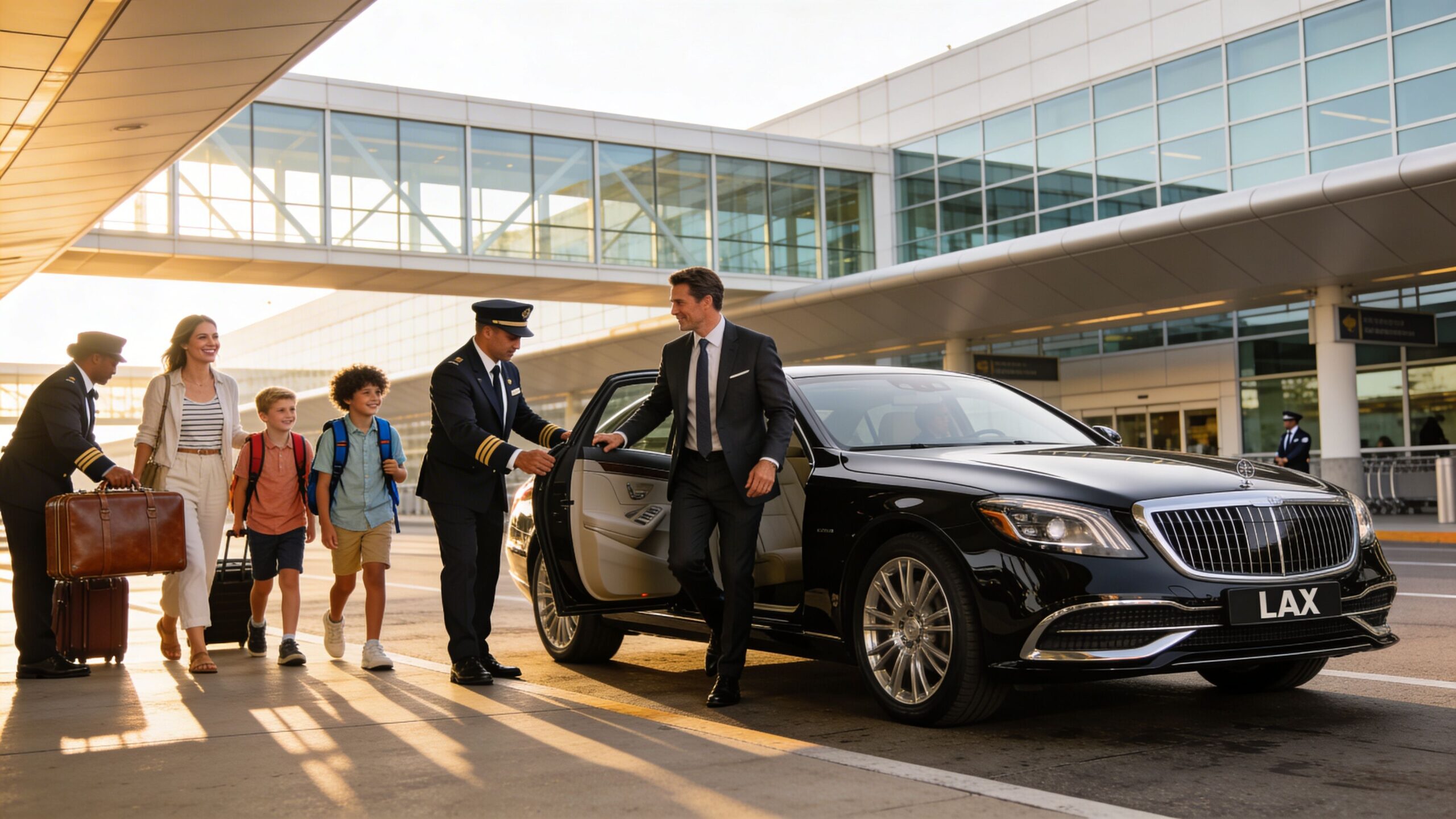
The right moment to use a managed service is when the transportation leg is carrying more than a passenger. It may be carrying a business relationship, a family logistics plan, an event timeline, or a reputation risk.
Executive travel and client-facing pickups
If the passenger needs a quiet, controlled environment and little tolerance exists for pickup confusion, a managed black car service makes sense. That includes C-suite travel, investor visits, board guests, and out-of-town clients.
Rides On Time Transportation is one option in that category. It provides airport transfers with flight tracking, Meet and Greet or curbside pickup, a range of vehicle classes, and 24/7 dispatch support. For a traveler whose schedule cannot absorb improvisation, those service components matter more than a lower entry fare.
Family travel with luggage and special requests
Families often underestimate how quickly a basic airport transfer becomes a logistics problem.
A stroller, checked bags, child seats, tired children, and an unfamiliar terminal flow all make the trip harder. In that setting, the value of a reserved vehicle, direct loading, and a driver who already knows the assignment is obvious. The ride is smoother because the decisions were made before landing.
Event and group movement
Event planners and coordinators need consistency more than they need spontaneity.
A shared app-based approach can work for one traveler. It gets fragile when you are moving multiple guests, VIPs, presenters, or family members on a set run-of-show. Group transportation works better when one operator can align vehicles, communicate updates, and keep accountability in one place.
Corporate travel management and duty of care
Travel managers should consider a structured provider when they need:
- Centralized oversight: One point of coordination for changing itineraries.
- Vehicle choice: Sedans, SUVs, vans, or larger options matched to traveler count and luggage.
- Cleaner policy alignment: Pre-booked service with clearer billing and fewer edge-case reimbursements.
The strongest use case is not “luxury travel.” It is high-consequence travel. If the traveler cannot miss the pickup, cannot be left sorting through airport confusion, and cannot risk a mismatch between service promised and service delivered, a managed provider is the rational choice.
Choose the lower-cost model when the trip can absorb variability. Choose the managed model when it cannot.
Frequently Asked Questions about LAX Car Services
What is a Meet and Greet service at LAX
Meet and Greet usually means the chauffeur or an airport representative coordinates the passenger inside or just outside the terminal arrival flow, often with direct identification and luggage assistance. The exact procedure depends on the provider and terminal rules.
For travelers who are new to LAX, arriving internationally, or hosting a guest, this reduces the chance of a missed connection between passenger and driver. It is less about luxury and more about removing confusion at the handoff point.
Can I request a child safety seat
Yes, many professional airport car services allow child seat requests in advance. The key is to request the correct type at booking and confirm it before the trip date.
Do not assume a provider will have the right seat available without notice. If the seat matters, make it part of the reservation record, not a same-day note.
How far in advance should I book
For business travel, family travel, early morning departures, and large-vehicle needs, book as early as practical. Advance booking gives the provider more room to assign the right vehicle and plan the pickup cleanly.
For standard leisure trips, a shorter booking window can still work. The more moving parts your trip has, the less you want to leave transportation to chance.
Are cancellation policies the same for every provider
No. They vary widely.
Professional car services typically publish a reservation policy covering cancellation windows, wait time, and airport pickups. Rideshare and shuttle policies operate differently because their service models are different. Read the terms before booking, especially if your itinerary may shift.
Is curbside pickup always better than other pickup methods
Not always. It depends on airport rules, terminal conditions, and the traveler.
For some passengers, curbside is the easiest option. For others, especially elderly travelers, families, or guests who need extra help, Meet and Greet may be worth the added coordination. The better question is not which method sounds better. It is which method reduces the chance of a failed pickup for this specific trip.
If your LAX transfer carries real consequences, Rides On Time Transportation is worth considering for pre-arranged airport service with flight tracking, chauffeur coordination, and vehicle options suited to solo travelers, families, executives, and groups. The right booking is the one that protects your schedule, your traveler, and your margin for error.