Somewhere between buying park tickets and deciding whether to rope-drop Fantasyland or head straight to Cars Land, many travelers hit the same snag. Getting to Disneyland from San Diego sounds simple until you start doing the math on time, traffic, parking, kids, bags, and who is going to be stuck driving home.
Trips either stay fun or start feeling like work when these factors are considered.
The route is familiar to Southern Californians, but it is not a small hop. If you are planning disneyland from san diego, the transportation choice shapes the whole day. A cheaper option can cost you park time. A flexible option can create parking stress. A comfortable option can save a family outing or keep a corporate group on schedule.
Your Magical Trip from San Diego to Disneyland Starts Here
A lot of travelers begin in the same place. They know Disneyland is close enough for a day trip, but not close enough to wing it.
Disneyland Resort sits in Anaheim, approximately 95 miles north of San Diego, and it opened on July 17, 1955. Today the resort spans about 500 acres, and its two parks drew a combined 27.3 million visitors in 2024, which is one reason reliable transportation matters so much on busy Southern California travel days (Disneyland Resort fact sheet).

For some travelers, the right answer is a same-day round trip. For others, the smarter move is pairing transport with an overnight stay so nobody is exhausted by the return drive. If you are weighing that option, this guide to smart choices for hotels near Disneyland is useful because hotel location changes how much pressure you put on your arrival and departure windows.
What usually goes wrong
The biggest planning mistake is treating the route like a static drive time instead of a live Southern California corridor.
People look at a map, see a reasonable drive, and assume the rest will sort itself out. Then traffic builds earlier than expected, one person in the group is late, a child seat needs to be reinstalled, or the family arrives flustered before they even scan into the park.
Tip: If your day has a fixed start, build around traffic reality first, not park optimism.
If you want a quick reference point on departure timing patterns for the broader corridor, this breakdown of the best time to drive from San Diego to Los Angeles is a helpful planning companion.
San Diego to Disneyland Travel Options at a Glance
For most clients, the decision comes down to five choices. Drive yourself, take the train, use a shared shuttle, book a rideshare, or reserve a private car.
The table below looks at the total experience cost, not just the cash price. That means time lost to transfers, stress around pickup reliability, luggage handling, and whether your group arrives together.
Comparison of San Diego to Disneyland Transportation
| Method | Est. Time (One-Way) | Est. Cost (Per Person) | Best For | Key Downside |
|---|---|---|---|---|
| Drive your own car | Usually around the common drive estimate, but highly traffic-sensitive | Qualitatively varies by fuel, parking, and vehicle costs | Families who want full control over stops and schedule | Driver fatigue, parking logistics, and unpredictable traffic |
| Amtrak plus local transfer | Multi-step trip with rail time plus the last-mile transfer from ARTIC | Around $28 per person from commonly cited travel discussions | Budget-conscious solo travelers and couples traveling light | The train does not drop you at Disneyland, so the trip is not door-to-door |
| Shared shuttle | Longer than a direct ride because pickups and drop-offs are stacked | Often lower upfront cost than private service | Solo travelers and pairs who value savings over speed | Extra stops can eat into park time |
| Rideshare | Direct when available, but timing and pricing fluctuate | Variable | Small parties wanting app-based booking without driving | Surge pricing, vehicle-size mismatch, and inconsistent long-route experience |
| Private chauffeured car or Sprinter | Direct route with the least transfer friction | Higher upfront cost, but stronger value for families and groups | Families with gear, executives, and group travel | Higher sticker price if you only compare fare and ignore time and stress |
The quick read
A solo traveler can often tolerate transfers and longer travel windows.
A family with strollers, backpacks, snacks, and tired kids usually cannot. A corporate group has another concern. Everyone needs to arrive together, on time, and ready for the day.
That is why the cheapest line item is not always the lowest real cost.
Driving Yourself The Classic SoCal Road Trip
Driving your own car is the default choice for many San Diego travelers because it feels simple. Put the address in your phone, head north, park, and enjoy the day.
In practice, self-driving works best when your group is small, your schedule is flexible, and one adult is comfortable owning the whole transport burden.
The drive looks easy on paper
Navigation apps often estimate the San Diego to Anaheim drive at 1 hour 45 minutes, but real-world traffic can add 45 to 90 minutes during peak periods. That gap is one of the biggest planning traps for time-sensitive Disneyland trips (Tripadvisor discussion on drive time variability).
That means the route is not just about distance. It is about when you leave, how much buffer you built in, and whether your driver can stay calm if traffic breaks against you.
Hidden costs that people underestimate
The obvious costs are fuel and parking. The less obvious costs are often bigger.
- Driver attention: One adult spends the morning focused on traffic instead of the trip.
- Arrival energy: A tense drive affects the first few park hours more than people expect.
- Exit fatigue: Leaving Disneyland late and driving back to San Diego is usually the hardest part of the day.
- Parking friction: Even after arrival, you still have the parking structure, tram or walk, and the end-of-night car retrieval.
Key takeaway: Self-driving offers control, but it transfers all risk management to you.
When self-driving works
Driving yourself makes sense if the group wants flexibility and can absorb delays without the day falling apart.
A few examples:
- A couple planning a relaxed visit with no dining reservations.
- A local family turning the drive into part of a larger Orange County day.
- Travelers who already know the corridor well and do not mind parking logistics.
When it stops making sense
Self-driving becomes harder to justify when the trip has fixed timing.
That includes:
- Early park strategy: You care about getting there without losing your first ride window.
- Small children: Car-seat setup, rest stops, and late-night return fatigue become a real factor.
- Corporate or client-facing travel: The driver arrives responsible for logistics instead of focused on the day.
If you are comparing route risk between freeway options, this guide to I-5 vs I-405 vs CA-73 route choice, travel times, and risk factors helps frame the decision the right way.
Riding the Rails Amtrak and Metrolink Explained
The train is the option people ask about when they want to avoid freeway stress. That instinct is reasonable. Rail travel can be calmer than driving.
But for disneyland from san diego, the train only solves part of the trip.
What the rail trip looks like
The basic pattern is straightforward. You board in San Diego, ride north to Anaheim Regional Transportation Intermodal Center, then arrange the last leg from the station to the Disneyland area.
That middle segment is the pleasant part. You are not fighting traffic, you can answer emails, and no one in your party is stuck behind the wheel.
The complication is the handoff after arrival. The train does not deliver you at the park gate. You still need a local connection.
The last-mile issue matters
For light packers, that extra step is manageable.
For families, it can be the turning point that makes rail less attractive:
- You unload bags, stroller, and souvenirs more than once.
- You coordinate children through another transfer.
- You rely on one more schedule, queue, or pickup point before you arrive.
That is why I rarely recommend rail for groups carrying more than they can comfortably manage in one move.
Best fit for train travel
The train usually works best for:
- Solo travelers who do not mind a transfer
- Couples traveling light
- Visitors who value a lower-stress main segment more than pure door-to-door efficiency
It works less well for large family groups and event parties that need everyone moving together.
For travelers thinking ahead about comfort details during a longer seated trip, this guide to extension seat belts for a safer, comfier ride can be a practical read.
Tip: On rail trips, pack for transfers, not just the ride. The easiest suitcase to manage is the one you do not have to wrestle through a station with a child in tow.
Shared Shuttles and Rideshare Services Compared
These two options sit in the middle of the market. Neither asks you to drive. Neither gives you the full control of a dedicated vehicle.
That sounds balanced. Sometimes it is. Sometimes it creates the worst kind of compromise.
Shared shuttle trade-offs
A shared shuttle can be a sensible economy choice if you are traveling alone or as a pair and have more time than urgency.
The problem is built into the model. You are buying a seat, not the vehicle. That usually means:
- Multiple pickups and drop-offs
- A wider timing window
- Less control if another passenger runs late
- Limited flexibility once the route is underway
For Disneyland trips, extra stops matter because they erode the most valuable part of the day. The beginning.
Rideshare convenience with caveats
Rideshare services are simpler than shuttles on paper. Open the app, request a car, and go direct.
That convenience is real, but so are the weak points:
- Vehicle type may not match your party’s needs.
- The driver may be excellent, or may treat the ride like any other pickup.
- Pricing can shift at the exact time you need a guaranteed departure.
- Return pickup from a high-demand zone can be less smooth than the outbound trip.
For one or two adults with minimal luggage, rideshare can be perfectly fine. For a family with child seats or a group trying to move together, it often becomes reactive instead of planned.
Which one is more predictable
Shared shuttles are more predictable on price.
Rideshares are usually more predictable on routing. But they are less predictable on all the things that matter around that route, including vehicle availability, pickup timing, and comfort.
If you are weighing those trade-offs through the lens of airport-style transfer planning, this article on the benefits of private vs shared shuttle services for San Diego to LAX transfers translates well to Disneyland travel too.
How to Choose the Right Transport for Your Trip
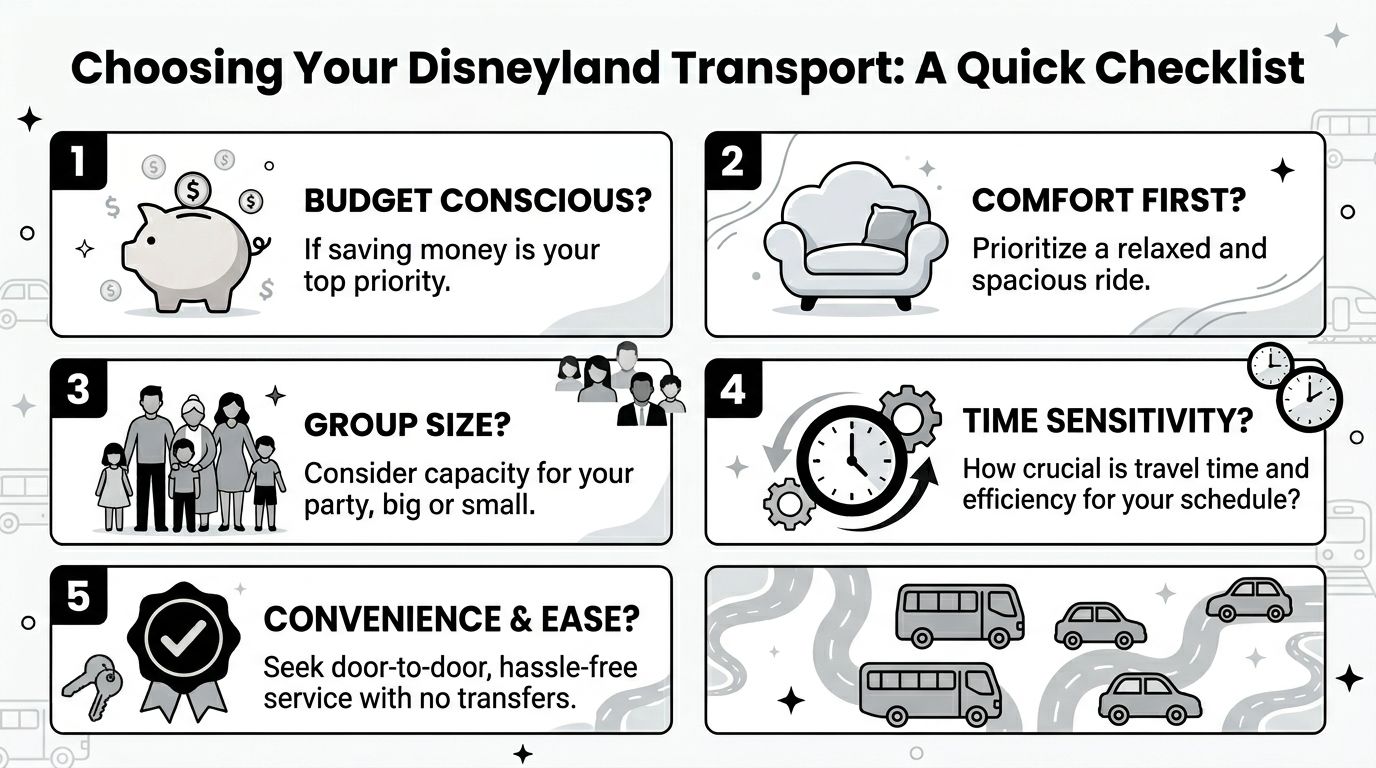
The right answer depends less on mileage and more on who is traveling, how fixed the day is, and how much friction your group can tolerate.
Most travel advice stops too early here. It compares solo options but skips the biggest real-world gap. Travel guides often overlook when groups of 6 to 15 should charter instead of trying to coordinate multiple cars or public transit tickets, even though that is a major issue for event organizers and large families (TouringPlans forum discussion on the gap in group transport guidance).
Solo traveler or couple
If your priority is minimizing cash outlay and you can handle a transfer, rail is often the practical answer.
If your priority is a direct trip without driving, rideshare may win, especially if you are packing light and can be flexible on return timing.
Family with young kids
Families should price the day as a full experience, not as transport fare alone.
A family carrying a stroller, snacks, extra clothes, and tired children usually benefits from door-to-door service. Even when the fare is higher, the reduced handling, fewer transitions, and easier end-of-night return can justify it quickly.
Practical rule: The more gear you bring, the less attractive transfer-based options become.
Group of friends, wedding party, or extended family
Often, people make the wrong call here.
Two or three separate cars may look cheaper at first glance. Then the problems start:
- One car leaves late.
- Parking and arrivals split the group.
- Some people want to leave early.
- Nobody agrees on the return plan.
For medium-size groups, one dedicated vehicle often becomes the cleaner solution because it consolidates timing, communication, and arrival.
Corporate outing or executive travel
Corporate travelers should make the decision based on reliability and the value of schedule protection.
A delayed arrival has a cost. So does a scattered arrival where half the group is texting from different lots, platforms, or pickup curbs.
For teams comparing providers, this checklist on how to compare limousine companies in San Diego is a useful filter for service standards, fleet fit, and dispatch capability.
The Ultimate Stress-Free Journey A Private Car Service
A private car service is not the right answer for every trip. It is the right answer when the trip has to work cleanly the first time.
That includes executive schedules, families with young children, and any group where convenience has real value.
Why the numbers matter here
For corporate travelers on the San Diego to Anaheim route, chauffeured services reach 99.5% on-time performance, compared with 92% for rideshare, and that reliability matters when Disneyland ticket value is benchmarked at $20 to $22.50 per hour. A 45-minute delay is not just annoying. It represents a direct loss of usable park or event time (Disneyland hourly value and transport reliability benchmark).
That same logic applies to leisure travel even if you do not phrase it like a travel manager. If your family loses the first hour to a bad handoff or delayed pickup, you feel it all day.
What a private service changes
A dedicated car or Sprinter removes the handoffs that create most of the stress:
- Door-to-door pickup
- One vehicle for your whole party
- No parking process
- No waiting on another passenger
- Room for child seats, bags, and day-trip gear
- A driver focused on the route so you do not have to be
This is also the one category where amenities matter. Wi-Fi, lap desks, room to work, and pre-arranged child seats are not luxury talking points. They solve specific trip problems.
A useful overview of what that service model includes is this page on what private car service means in San Diego.
One local option in that category is Rides On Time Transportation, which operates sedans, SUVs, Mercedes Sprinters, and mini-coaches for Southern California transfers.
Best use cases
Private service earns its keep fastest in three scenarios:
- Families who want the day to start calmly and end without a parking-lot march.
- Corporate groups that need everyone together and on schedule.
- Celebration groups such as birthdays, wedding parties, or multi-generational trips where nobody wants to be the designated driver.
A short look at the travel experience helps make the difference clear:
Your Disneyland Travel Questions Answered
How much luggage is realistic?
For a same-day Disneyland trip, most travelers should pack smaller than they think.
A sedan works for light personal items. Families usually need more room once you add a stroller, jackets, snacks, and park purchases. Train travel can handle more luggage in theory, but every extra bag becomes your problem during transfers.
Do I need to pre-book child seats?
Yes, if your transportation provider offers them.
Do not assume a vehicle will have the correct seat ready without advance notice. Families should confirm the seat type when booking and again before pickup. That one detail changes whether departure feels organized or chaotic.
How far ahead should I book?
Book earlier when your group is larger, your travel day is fixed, or the trip connects to a flight, event, or dining reservation.
For solo travelers using rail or rideshare, flexibility is easier. For families and groups, last-minute planning narrows your good options quickly.
Is it worth flying instead of driving from San Diego?
For a trip originating in San Diego, flying is usually the wrong tool for this job.
You trade a simple regional ground transfer for airport timing, check-in requirements, and another layer of coordination. For disneyland from san diego, the issue is not crossing a long distance. It is managing the corridor efficiently.
If you want a direct, planned ride instead of piecing together transfers, parking, and pickup uncertainty, Rides On Time Transportation offers San Diego to Anaheim service with sedans, SUVs, Sprinters, and mini-coaches for families, executives, and groups that need a smoother trip.