You’re probably booking under pressure.
Maybe you’re an executive assistant trying to move a team from LAX to downtown San Diego without missed pickups, baggage chaos, or a vehicle that looks wrong for the client. Maybe you’re a maid of honor trying to keep a wedding party on schedule while making sure guests get back to their hotels safely. In both cases, the challenge isn’t finding a san diego limousine bus. It’s finding the right vehicle, at the right price, with the right credentials, and then building a plan that works on event day.
Most pages about limo buses stop at photos, LED lights, and “luxury experience” language. That’s not enough. A first-time booker needs to know how to separate a Sprinter from a party bus, how to read a quote, what to ask about permits and insurance, and how to handle SAN, LAX, and CBX transfers without creating a mess for the people riding.
A smooth charter usually comes down to a few simple decisions made early. Vehicle fit. Routing. contract clarity. Compliance. Driver communication. If those are handled well, the ride feels effortless. If they aren’t, even a beautiful bus won’t save the day.
Understanding Your San Diego Limousine Bus Options
Booking a san diego limousine bus is a lot like choosing a hotel room. You don’t book the penthouse for a quick airport overnight, and you don’t cram a wedding party into a standard room. The vehicle should match the purpose of the trip, the tone of the event, and the kind of passengers you’re moving.
A limousine bus sits between black car service and a full-size charter. It gives a group private transportation with more room, more amenities, and a more polished arrival than standard rideshare options. In San Diego, larger limousine buses are often built on Ford F-450 chassis with extended wheelbases for groups up to 45 passengers, and those diesel platforms deliver 1,050 lb-ft of torque while reducing operating costs by 20 to 25% per mile compared with gasoline counterparts, which helps some providers keep transfer pricing flat rather than layering in surcharges. The same chassis class also supports advanced safety systems that can mitigate rollover risk by 30 to 40% on highways, according to the fleet benchmark at Presidential Limousine fleet details.
Three categories that matter
For most first-time bookers, the decision comes down to three practical vehicle styles.
| Vehicle Type | Passenger Capacity | Best For | Key Features |
|---|---|---|---|
| Mercedes Sprinter | Small groups | Executive airport transfers, CBX runs, VIP dinners | Discreet look, easier hotel access, lounge seating, upscale interior |
| Grech mini-coach | Mid-size groups | Corporate events, wedding guest shuttles, conference movement | More luggage room, easier boarding, polished coach-style comfort |
| Classic limo or party bus | Large celebratory groups | Birthdays, bachelor or bachelorette parties, nightlife, concerts | Entertainment-focused cabin, social seating, party atmosphere |
A Mercedes Sprinter works well when you want the ride to feel premium but not theatrical. It’s the right call for executive groups, airport transfers, and clients who don’t want to step into a bus with nightclub energy. If your passengers are carrying laptops, garment bags, or conference materials, this category usually fits the assignment better than a party setup.
A Grech mini-coach is often the sweet spot for larger but still professional groups. It feels organized. Boarding is easier. Luggage handling is better. If you’re moving attendees between a hotel, convention venue, dinner, and return transfer, this is often the cleanest operational choice.
Don’t confuse celebration with suitability
The classic party bus has its place. It’s built for atmosphere first. That can be exactly right for a birthday, prom, concert night, or wedding after-party. It can also be exactly wrong for board members, legal teams, and clients arriving from a long-haul flight.
Practical rule: If the riders need to arrive composed, book for comfort and discretion. If the riders want the trip itself to be part of the event, book for energy.
When comparing fleets, look at the operator’s actual vehicle mix, not just category names. “Limo bus,” “shuttle,” and “party bus” are often used loosely. A useful starting point is reviewing a provider’s San Diego fleet diversity options and then asking for the exact vehicle you’ll receive, not just a generic class description.
Questions that narrow the field fast
Before you request a quote, know these four things:
- Group size: Count actual riders, not just invitees.
- Baggage profile: Airport bags, garment bags, golf clubs, and trade show materials change the vehicle choice.
- Tone of service: Executive, wedding-elegant, or party-focused.
- Route shape: One-way transfer, hourly standby, or multi-stop itinerary.
That short list prevents the most common mismatch in this market. People book by passenger count alone, then realize too late that the vehicle doesn’t fit the luggage, mood, or schedule.
Decoding Limousine Bus Pricing in San Diego
The easiest way to overspend on a san diego limousine bus is to compare quotes that aren’t built the same way.
Some operators quote an hourly base and add fees later. Others package the ride around an event window. Others use flat transfer pricing for airport and point-to-point work. None of those models is automatically wrong. The mistake is assuming they’re interchangeable.
As a benchmark, premium providers in the market often price by vehicle class, with sedans around $65 per hour, stretch limos at $125 per hour, and large SUV limos such as Hummers at $225 per hour, according to Top Dog Limo Bus pricing FAQs. Those figures are useful as orientation, not as a universal quote for every trip, because route complexity, waiting time, and vehicle type still matter.
The three quote formats you’ll see
Hourly service is common for weddings, nights out, and events with uncertain timing. It gives flexibility, but you need to ask what counts toward billable time. Some reservations start the clock at garage departure, while others start at pickup.
Flat-rate transfers work best for SAN, LAX, hotels, cruise terminals, and direct venue moves. This is often cleaner for corporate assistants because the budget is easier to approve and less vulnerable to overtime.
Packages show up most often for winery tours, wedding blocks, and event bundles. They can be good value if the schedule is fixed. They can also hide assumptions that don’t fit your day.
What turns a good quote into a bad invoice
A low starting number isn’t the same as a low final number. Ask for a written breakdown that covers every likely charge.
- Fuel rules: Long-distance trips and out-of-county runs sometimes trigger extra charges.
- Gratuity treatment: Ask whether it’s included, suggested, or mandatory.
- Cleaning exposure: This matters for celebratory groups.
- Overtime terms: Get the increment and rate in writing before you book.
- Waiting time: Airport arrivals and venue delays can change the bill.
A quote you can’t explain in one minute is a quote that can surprise you later.
The route itself also changes value. A wedding shuttle with multiple hotel loops needs different planning than one airport pickup. A SAN transfer may fit neatly into a flat rate. A same-day LAX to San Diego move with return standby is a different cost structure entirely.
A practical way to budget is to compare providers by total trip cost, not base rate. If you want a deeper framework for that comparison, this guide on how to budget for a luxury limo experience is a useful checklist for reviewing line items before you approve a reservation.
What usually works best
For airport and corporate movement, flat pricing with confirmed inclusions is usually the least stressful. For weddings, hourly service often works because timelines drift. For leisure outings, packages can work well if pickup, stops, and return time are already known.
Cheap transportation rarely stays cheap once the event starts moving.
Top Use Cases for San Diego Group Transportation
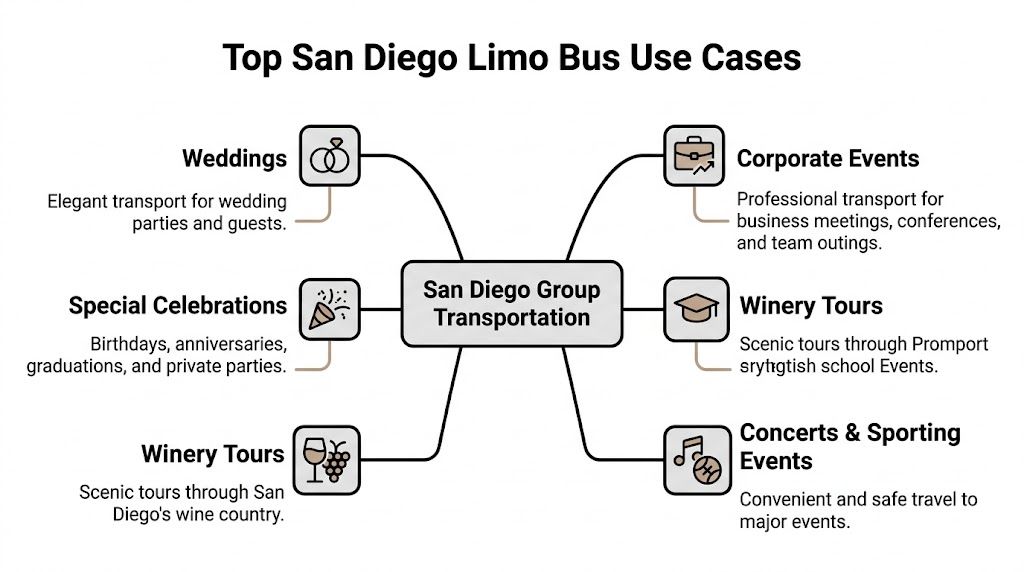
A san diego limousine bus solves different problems depending on who’s booking it. The transportation itself may look similar from the outside, but the underlying value changes with the job.
For a corporate assistant, success means no one has to ask where the driver is. For a wedding planner, success means guests arrive together and leave safely. For a leisure group, success means nobody has to drive, park, or split into five separate cars.
Corporate moves that need more than a driver
The cleanest corporate bookings usually involve one of two patterns. Either a team is arriving in waves and needs airport coordination, or a group needs scheduled transportation between hotel, convention venue, meals, and return.
Vehicle choice and dispatch discipline matter more than décor. A quiet Sprinter or mini-coach is often a better fit than an entertainment-focused bus. Flight tracking, direct chauffeur communication, and enough luggage space matter more than mood lighting when your riders are carrying roller bags and presentation materials.
Some providers are also better equipped for multi-airport planning. That matters because CBX passenger volume was up 30% year over year to 2.1 million in early 2026, and about 40% of those travelers were group passengers, creating more demand for operators that can handle LAX, SAN, and CBX combinations without dropping details, as noted by San Diego Limo Buses market observations. If your itinerary includes airport arrival, overnight stay, and next-day cross-border movement, ask whether the operator has handled that exact sequence before.
Wedding movement that protects the timeline
A wedding shuttle doesn’t just move people. It protects the schedule.
A well-run plan usually starts with a dedicated vehicle for the wedding party or immediate family, then separate guest transportation between hotel blocks, ceremony, reception, and return hotels. The reason this works is simple. You’re not relying on guests to deal with traffic, parking, or directions while dressed for a formal event.
The common failure point is underestimating load time. Guests don’t board like commuters. They board like wedding guests. There are dresses, heels, jackets, photos, and someone who always needs “one more minute.”
- Ceremony timing: Build in buffer before guest-facing start times.
- Hotel loops: Keep pickup points simple and clearly named.
- Return waves: Offer more than one departure if the event spans several hours.
If one late shuttle can delay the ceremony or strand guests at the reception, transportation isn’t a side detail. It’s part of event control.
For organizers planning group movement around celebrations, venue transfers, or multi-stop event logistics, it helps to review examples of event and group transportation service types before locking in the route.
Leisure trips where the route is the product
Leisure charters usually fall into three buckets. Winery tours, concerts and sporting events, and cross-border airport transfers.
A Temecula wine day works best when the operator understands pacing. Guests need a realistic departure time, a sane number of stops, and a plan for food and water, not just a driver with directions. Concert and sporting event service works when pickup and return zones are preplanned so the group doesn’t scatter after the show.
CBX is its own category. The trip sounds simple until you add bags, passports, staggered arrivals, and tired travelers. Groups often benefit from a quieter luxury vehicle rather than a bus with party styling, especially if the transfer is tied to a longer travel day.
Your Ultimate Limousine Bus Booking Checklist
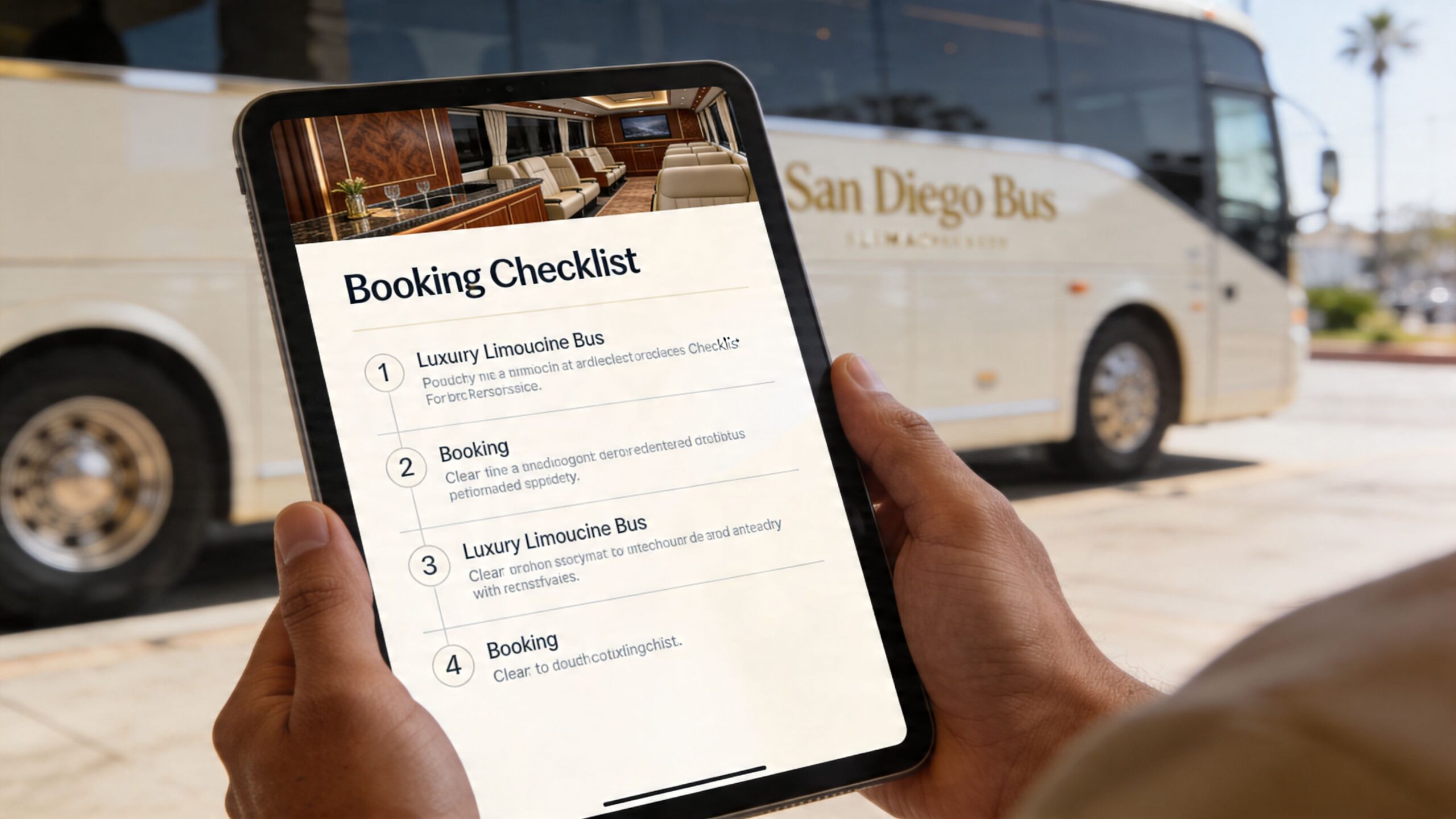
Good bookings are built backward from the event date. The people who have the easiest ride day usually did the least scrambling in the final week because they handled the right questions early.
Start with the event math
Before you contact anyone, write down the operational basics in one place:
- Headcount: Confirm riders, not estimated invite totals.
- Stops: List each address in actual order.
- Timing: Note hard arrival times and flexible windows.
- Special load needs: Luggage, dress bags, signage, child seats, coolers, accessibility concerns.
This single page saves time because every provider will ask for some version of it. It also reveals whether you need one vehicle, multiple vehicles, or staged pickups.
Ask questions that expose weak operators
Most first-time bookers ask about price first. Professionals ask about execution first.
Use this checklist during the quoting process:
- What exact vehicle am I reserving? Ask for year, make, model, and current photos.
- What is the luggage assumption? Passenger count without baggage context can mislead you.
- Where does the billable time start and end? Don’t assume.
- Who is my day-of contact? Dispatch and driver contact should be clear.
- What happens if my flight or event runs late? Listen for an actual process, not vague reassurance.
- Is the quote fully itemized? You want taxes, gratuity treatment, waiting time, overtime, and any surcharges addressed.
- Can you confirm pickup procedure in writing? This matters for airports, hotels, private homes, and venues.
Build the final week like a production schedule
The last seven days matter more than generally realized. Confirm every detail again, even if the reservation was made months earlier.
- Reconfirm names and mobile numbers: Make sure the right rider contacts are attached.
- Verify addresses: Venue names are not enough. Use full street addresses.
- Distribute pickup instructions: Send one clear message to the whole group.
- Review timing assumptions: Especially for weddings, airport arrivals, and stadium events.
- Assign one transportation lead: One person should make decisions if the schedule shifts.
Booking habit that works: Treat the vehicle reservation like a mini event plan, not a car booking.
You’ll also save yourself trouble by using a standard review process before signing. A practical template is this car service booking checklist, which mirrors the way experienced assistants and planners typically vet a reservation before handing over deposits.
Day-of details people forget
Three small details prevent a lot of confusion:
- Name the pickup lead. One rider should be responsible for gathering the group.
- Tell guests what the vehicle is. “White mini-coach” is better than “the shuttle.”
- Set boarding expectations. If departure is at 5:15, don’t tell guests 5:15 means gather then.
Transportation problems usually look like timing problems. In reality, they’re usually communication problems wearing a timing costume.
Verifying Contracts Insurance and Safety Compliance
This is the part often overlooked until something feels off.
A polished website and a nice vehicle photo don’t tell you whether the operator is legal, insured for commercial passenger service, or maintaining vehicles the way they should. If you’re moving executives, wedding guests, family, or out-of-town clients, that isn’t a minor detail. It’s the core of the booking.
A 2025 CPUC report highlighted that 15% of inspected San Diego limo services failed safety audits, and 8 incidents in the last year were linked to unpermitted operators, according to SD Charter’s summary of the regulatory gap. That matters because many buyers still assume anyone advertising limousine or bus service is operating under the right authority. That assumption can expose a company, event host, or planner to unnecessary risk.
What to demand before you pay
Start with the contract. A legitimate operator should provide terms that are specific enough to protect both sides.
Look for these items:
- Named service details: Date, times, addresses, vehicle type, and pricing structure.
- Cancellation terms: Deposits, cutoffs, and how changes are handled.
- Overtime language: Rate, billing increment, and authorization process.
- Damage and cleaning clauses: Especially important for celebratory events.
- Insurance and permit identification: These shouldn’t be mysterious.
Then move to compliance documents. For limousine buses in California, a valid CPUC permit is not optional. Ask for the permit or TCP number and ask the company to identify the commercial insurance backing the trip. If the booking involves airports, executive travelers, or a corporate travel desk, also ask how they document maintenance and driver vetting.
Why this matters more for corporate and airport work
Corporate assistants often need a transportation vendor that can satisfy procurement, risk, and traveler confidence all at once. That means the operator should be able to speak clearly about insurance, permits, maintenance records, and dispatch process. If they can only talk about interiors and amenities, that’s a warning sign.
Airport and multi-stop work raise the stakes because timing pressure can tempt weak operators to cut corners. You don’t want to discover day-of that the provider is vague about credentials, subcontracting, or liability.
A good outside reference for understanding the broader regulatory baseline is this overview of DOT Passenger Bus Regulations. It helps non-specialists understand why documentation, maintenance discipline, and driver oversight matter long before pickup time.
How to verify without becoming a compliance officer
You don’t need to turn into a transportation auditor. You do need to be willing to ask direct questions and pause if the answers are slippery.
Use a simple standard:
- Can they identify their operating authority clearly?
- Can they provide proof of commercial insurance?
- Can they explain who is operating the vehicle?
- Can they describe maintenance and chauffeur screening in plain language?
If a company avoids paperwork questions, assume the paperwork won’t help you later.
For buyers who want a provider’s general standards in one place, some operators publish their transportation safety practices so clients can review expectations before booking. That kind of transparency is more useful than generic promises about “safe rides.”
The contract should make you calmer after reading it. If it leaves you guessing, keep shopping.
Beyond the Ride Amenities and Corporate Benefits
Once the vehicle type and compliance are squared away, the next question is experience. Not cosmetic experience. Functional experience.
The best limo bus amenities are the ones that support the purpose of the trip. On a wedding day, that might mean music, lighting, and enough comfort for a dressed-up group to stay relaxed between venues. On a corporate move, it might mean Wi-Fi, space to regroup, and an interior that feels private rather than theatrical.
Amenities that actually change the ride
Top-tier 20 to 40 passenger limo buses often include 18-speaker surround sound systems rated at 2,000 to 5,000 watts, multiple HDTVs, and custom interiors with noise-dampening foam that reduces road noise by 15 to 20 dB, according to WeddingWire’s Top Dog Limo Bus listing details. That matters most on longer runs, where cabin noise and layout affect whether passengers feel energized or spent when they arrive.
The same benchmark notes features like dual bars and Bluetooth-synced LED lighting, which can be a strong fit for celebration-focused bookings. Those features create momentum for the event itself, rather than treating transportation as dead time.
Match the cabin to the job
A few pairings tend to work well:
- Executive transfers: Quiet interiors, charging access, Wi-Fi, and a restrained look.
- Wedding party movement: Comfortable seating, climate control, polished finish, and room for formalwear.
- Celebration runs: Strong audio, visual features, social seating, and lighting controls.
The right amenity is the one passengers notice by how easy the ride feels, not by how long the feature list is.
For corporate teams, account structure matters almost as much as the bus itself. Dedicated billing, flat-rate clarity, saved traveler profiles, and a dispatch line that answers quickly are not glamorous features, but they remove friction from repeated travel. A transportation partner that can support SAN, LAX, SNA, or city-to-city movement under one account usually saves more administrative time than a one-off booking process ever will.
The wrong luxury feature set can also make a trip harder. A dance-forward interior for a finance team. Not ideal. A stripped-down shuttle for a wedding party trying to celebrate between venues. Also not ideal.
Sample San Diego Limousine Bus Itineraries
A strong itinerary makes the vehicle feel like part of the event instead of a separate errand. These sample plans show how a san diego limousine bus can support the full day, not just the first pickup.

Corporate VIP day
A mid-size executive group arrives at SAN in the morning. A mini-coach handles luggage cleanly and moves the team to a downtown hotel for bag drop, then to a convention or client meeting. In the evening, the same vehicle takes the group to dinner in La Jolla and returns them to the hotel.
This setup works because one vehicle and one dispatch thread reduce confusion. No one is piecing together rideshare receipts, and the organizer has one point of contact all day.
Temecula wine day
A leisure group departs late morning from coastal San Diego, heads to Temecula for a lunch stop and a few winery visits, then returns before the night turns long. This works best with a realistic pacing plan. Don’t overload the day with too many stops. Build in time for photos, restrooms, and slow boarding.
A celebration-focused limo bus can fit this outing well if the group wants the drive itself to feel social.
For a sense of the ride style and pacing many groups look for, this video gives useful visual context:
Wedding day shuttle plan
Start with one early movement for the wedding party or immediate family. Later, run a dedicated guest shuttle from the hotel block to the ceremony and then onward to the reception. End the night with return loops back to the hotel.
The key is separating VIP timing from guest timing. One vehicle trying to do both can create avoidable stress if the photography schedule shifts or boarding takes longer than expected.
Keep the itinerary simple enough that someone else could run it if your point person gets pulled into the event.
The best itinerary is the one that still works when the day runs a little late.
Frequently Asked Questions About Limo Bus Rentals
What’s the difference between a limousine bus and a party bus
A limousine bus usually refers to a more polished group vehicle that can work for airport transfers, corporate moves, weddings, and upscale events. A party bus leans harder into entertainment and nightlife styling. In practice, companies often blur the labels, so ask for photos of the exact vehicle and interior.
Can passengers drink alcohol on board
That depends on the vehicle type, the passengers, and the operator’s policy. Never assume alcohol is allowed just because the vehicle has cup holders, coolers, or bar-style features. Ask for the company’s written policy before the trip, especially if minors are part of the group.
How far in advance should I book
For major weekends, weddings, conventions, and peak event periods, earlier is better. The more specific your vehicle requirement is, the earlier you should reserve. If your group needs airport coordination, multiple stops, or a particular interior style, don’t wait until the last minute.
Is gratuity included in the quote
Sometimes yes, sometimes no. Ask whether gratuity is included, mandatory, separate, or left to the client’s discretion. Get the answer in writing with the full quote so there’s no confusion when the final invoice arrives.
Are airport and CBX transfers better on an hourly booking or a flat rate
Usually, direct airport transfers are easier to manage with a flat rate. If the trip includes waiting, multiple passenger waves, or extra stops, hourly service may make more sense. The better choice depends on how fixed your schedule is.
What if my group size changes after booking
Tell the provider as soon as possible. Group size changes can affect luggage fit, legal seating, and the suitability of the reserved vehicle. A last-minute increase is one of the most common reasons an otherwise solid plan starts to wobble.
If you need help planning a san diego limousine bus reservation that includes airport coordination, wedding shuttle logistics, or CBX and LAX routing, Rides On Time Transportation handles private group transportation across Southern California with sedans, SUVs, Mercedes Sprinters, and mini-coaches, along with flight tracking, 24/7 dispatch, and corporate account support.