The last stretch before a cruise is where good trips often get shaky. Bags are zipped, passports are checked twice, and then significant pressure begins. Will the car show up on time? Will everyone fit with the luggage? Will traffic into downtown San Diego turn a simple transfer into a stressful scramble?
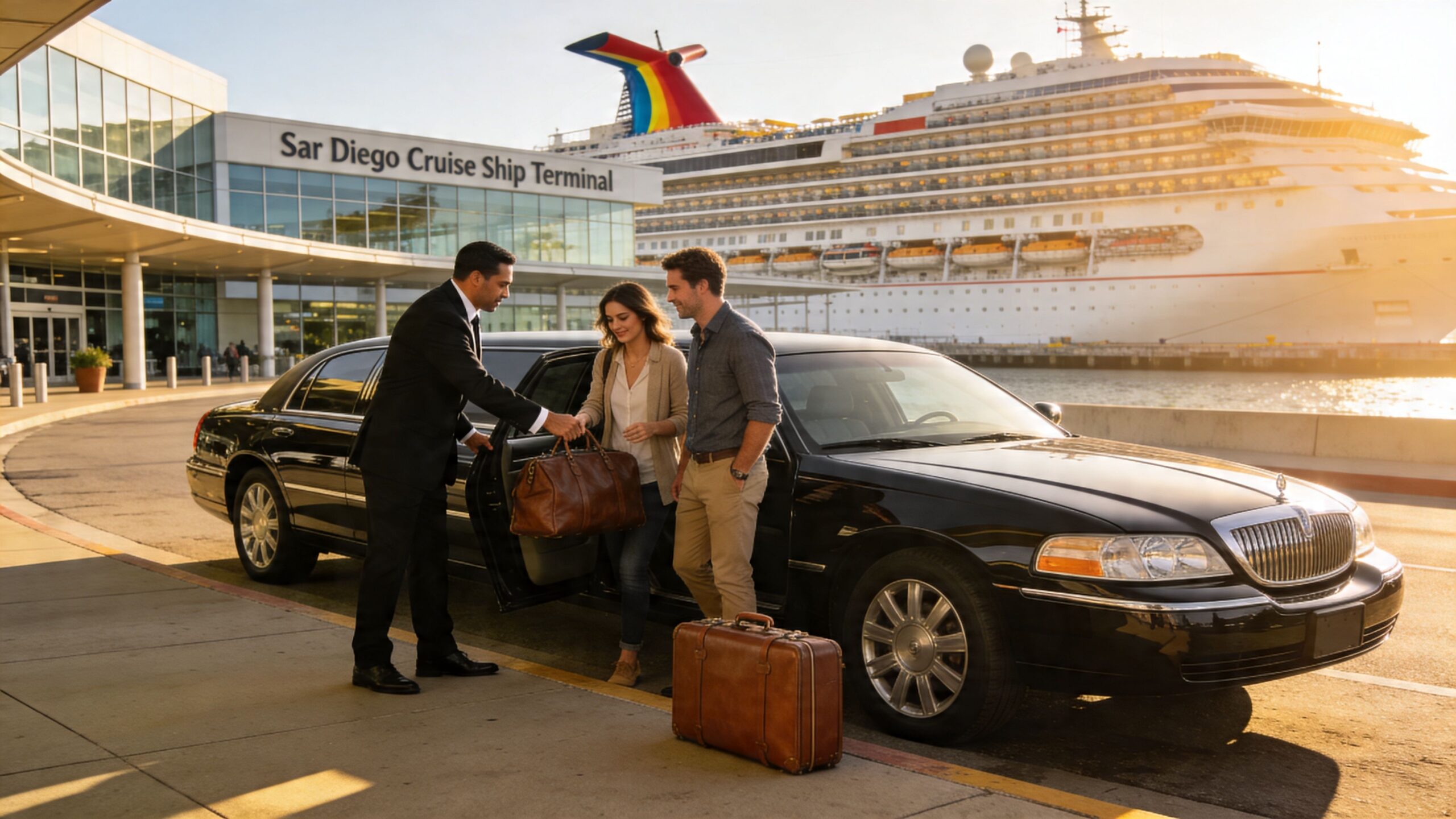
That’s why Black Car Service to San Diego Cruise Ship Terminal isn’t just about style. It’s about control. Cruise departures run on fixed schedules, and ground transportation needs to match that reality. A polished vehicle matters, but the primary value is a chauffeur who knows the port, a dispatcher who tracks timing, and a booking process that accounts for baggage, pickup windows, and route risk before travel day starts.
Start Your Cruise Vacation Before You Reach the Port
You’re outside a hotel near the harbor at 10:45 a.m. Four passengers, six rolling bags, two carry-ons, and a cruise check-in window that will not wait. The wrong vehicle turns a short ride into a curbside repack, a second car request, or a late arrival with everyone already irritated.
That is the part travelers underestimate.
A properly arranged transfer settles the two problems that cause the most trouble on cruise day. First, the luggage count has to match the vehicle, not just the passenger count. Second, the route into the terminal has to account for downtown congestion, event traffic, and terminal curb backups. If you’re comparing options, a dedicated San Diego black car service is built for that kind of planning before the pickup ever starts.
What travelers usually miss
The port is close to the airport and many hotels, but proximity does not protect you from delays. The primary pressure points are staging at pickup, fitting the bags without guesswork, and arriving at the cruise terminal during one of the busiest curbside periods of the day.
I tell clients to stop asking only, “How many seats does it have?” For cruise transfers, the better question is, “How many large suitcases fit with those seats in use?” That trade-off matters. A luxury sedan may be perfect for two passengers with light luggage. Put four adults and full-size cruise bags into the same plan, and the mistake shows up at the trunk.
Traffic strategy matters just as much. Harbor Drive can slow down fast when cruise passengers, hotel shuttles, taxis, and airport traffic all converge within the same window. A professional transfer starts with a realistic pickup time, not optimistic map timing. Good dispatchers build in margin, choose the cleaner approach based on the hour, and avoid forcing passengers into a rushed unload at the terminal.
Practical rule: Book your cruise transfer by passenger count, bag count, and pickup window together. Leaving out any one of those details is how simple port rides get expensive and stressful.
A good black car service improves the start of the trip because the decision-making is already done. The chauffeur knows the pickup point. The vehicle fits the group and the bags. The route has been planned around port traffic, not left to chance.
That is what passengers remember first. They step out at the terminal organized, on time, and ready to board.
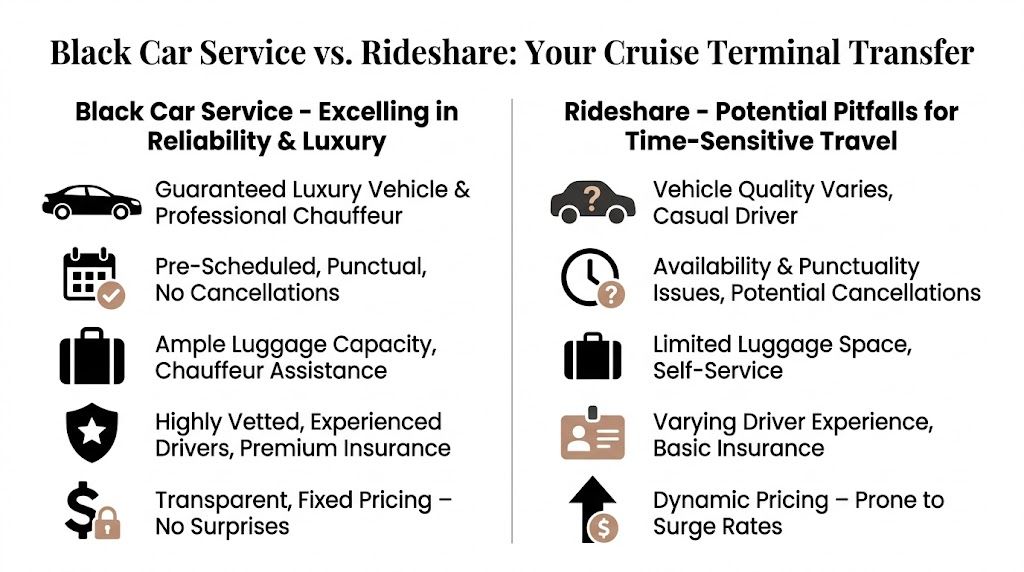
Why a Black Car Service Excels Where Rideshares Falter
A cruise terminal transfer is not the same as a dinner reservation pickup. The requirements are more stringent, the baggage load is heavier, and timing isn’t flexible. That’s where rideshares often look cheaper on the screen and weaker in practice.
Reliability is the product
With a black car service, the reservation is the commitment. The vehicle type is assigned intentionally, the chauffeur is commercially operating, and the trip is built around your embarkation window.
With a rideshare, the app is trying to find whoever is available. That model can work for low-consequence errands. It’s a gamble for a cruise departure.
What separates professional service isn’t just polish. It’s operating discipline:
- Pre-scheduled execution: your ride is dispatched against a booking, not left to live-market availability.
- Port familiarity: chauffeurs understand where to stage, where to unload, and how to avoid wasting time at the curb.
- Luggage help: cruise travelers rarely travel light, and self-loading at a busy terminal slows everything down.
- Vehicle consistency: you book a class that fits the group instead of hoping the arriving car matches the app label.
Port knowledge beats generic navigation
One of the clearest advantages is local terminal knowledge. Professional chauffeurs familiar with Port of San Diego operations know optimal drop-off locations and can manage curbside logistics, using real-time traffic monitoring to avoid delays that can add 20-45 minutes during peak cruise seasons, as noted in this cruise port chauffeur logistics guide.
That matters more than people think. A driver can have GPS and still lose time if they don’t understand how cruise traffic behaves at the port entrance.
The best transfer is the one that feels uneventful. No circling, no unloading confusion, no “is this the right side?” conversation while traffic stacks behind you.
What works and what doesn’t
What works is simple. Book a service built for scheduled transportation, give accurate party details, and use a vehicle with enough room.
What doesn’t work is assuming any car will do because the port is “close,” or that a rideshare SUV automatically means enough luggage space for cruise bags. That’s where small mistakes become last-minute problems.
For this trip, you’re not buying a ride across town. You’re buying certainty.
Decoding the Fleet Choosing the Right Vehicle for Your Group
Vehicle choice is where many cruise bookings go wrong. Not because people choose too little luxury, but because they choose too little space.
Cruise passengers usually carry more than airport-only travelers. Formalwear, extra shoes, garment bags, and larger checked luggage add up fast. For groups, the key question isn’t “How many seats?” It’s “How many people plus how many bags?”
Start with bags, not passengers
A sedan may look sufficient for two or three travelers on paper. It may not be sufficient once the luggage is loaded. If your group is cruising, count every large suitcase, every carry-on, and any bulky item before you choose the vehicle class.
For groups with significant luggage, vehicles like the Cadillac Escalade ESV and Mercedes Sprinter are critical, offering over 80 cubic feet of cargo space to accommodate the 2-4 pieces of checked luggage per person typical for cruise travel, according to this San Diego black car fleet guide.
If you want a sense of available vehicle categories before booking, a provider with a visible diverse San Diego fleet makes the decision much easier because you can match the trip to the equipment instead of guessing.
Rides On Time Vehicle Selection Guide
| Vehicle Type | Max Passengers | Ideal For | Luggage Capacity (Approx.) |
|---|---|---|---|
| Executive Sedan | 2-3 | Couples, solo travelers, light packers | Best for a modest luggage load |
| Luxury SUV | 4-6 | Families, small groups, travelers with multiple larger bags | Better for heavier cruise luggage |
| Mercedes Sprinter Van | Up to 14 | Extended families, wedding parties, corporate groups | Best option for large groups and substantial baggage |
Practical matching examples
Here’s the simplest way to think about it.
- A couple with standard cruise luggage: a sedan often works if you have a controlled bag count and no oversized items.
- A family group: move up to an SUV sooner than you think. Children’s items, carry-ons, and extra cruise bags eat up trunk room quickly.
- A celebration group or multi-cabin booking: choose a Sprinter. Keeping everyone in one vehicle is cleaner, calmer, and easier at the curb.
Where people miscalculate
Travelers often count only checked bags. That’s the mistake. Garment bags, backpacks, tote bags, and pre-cruise shopping all take space. Another common mistake is choosing an SUV for the seating and forgetting that the third row can reduce cargo flexibility depending on loading.
Capacity check: If anyone in the group says, “We can probably make it fit,” you probably need the next vehicle up.
The right vehicle does two things at once. It protects your schedule and it protects the mood of the trip. Nobody wants the first family argument of the vacation to happen over trunk space in the hotel driveway.
The Seamless Airport to Cruise Terminal Transfer Process
A cruise day transfer goes wrong in predictable ways. The flight lands late, baggage claim drags, the pickup point is unclear, and the car that looked fine on paper turns into a tight fit once the full luggage count hits the curb. A well-run black car transfer prevents those problems before you leave the airport.
For airport arrivals, the work starts before touchdown. Flight tracking matters because airline schedules shift, gate assignments change, and baggage delivery is rarely as fast as travelers expect. A proper airport-to-port reservation is built around live flight activity, a defined pickup method, and the actual bag count for the group. If you are comparing pickup formats, this San Diego airport transportation guide explains the difference between curbside pickup and meet-and-greet service.
What the handoff should feel like
SAN is close to the cruise terminal, but short distance does not guarantee an easy transfer. The trouble spot is timing. Airport exit traffic, downtown congestion, and cruise embarkation activity can slow a simple port run at exactly the wrong moment.
That is why the arrival plan should be settled before travel day:
- The reservation is tied to your flight details, not only a guessed arrival time.
- The chauffeur has clear instructions for curbside pickup or meet-and-greet.
- The luggage count is confirmed in advance so the vehicle is sized correctly.
- The route is adjusted based on real-time traffic near the airport and the waterfront.
Meet-and-greet often makes more sense for cruise passengers, especially for families, older travelers, and groups with heavy baggage. It removes the airport pickup scramble and shortens the time spent figuring out where to stand, who to call, and how to move six or eight bags through a crowded terminal frontage.
From baggage claim to terminal curb
Once the bags are loaded, local port experience starts to matter. A chauffeur who handles cruise runs regularly knows which terminal approach is moving, where traffic tends to stack up, and how to unload without turning the curbside drop into a delay. That matters more than polished language or a luxury label.
This short video gives a feel for what that polished transfer experience looks like in practice.
A smooth arrival is operational. It comes from accurate dispatching, enough luggage space, clear pickup instructions, and a driver who already knows the port routine.
That is what you pay for when the ship leaves on schedule.
Understanding Flat-Rate Pricing and All-Inclusive Fares
Flat-rate pricing matters most when traffic is least predictable. Cruise travelers often focus on the headline fare, but a key benefit is knowing the cost won’t swell just because the road gets slower.
A fixed quote gives you a defined transportation cost before the ride begins. That’s useful for families budgeting a vacation, and it’s just as useful for executive assistants who need clean expense planning.
What a strong flat rate should include
A quality quote should be simple to understand. You want to know whether the fare covers the vehicle, the chauffeur’s time, standard handling, and waiting policy. If those details are vague, the quote isn’t finished.
One useful benchmark is that Rides On Time offers transparent flat-rate pricing, such as approximately $125 for an executive sedan from La Jolla to the terminal, which includes a 60-minute complimentary wait time and full luggage handling, as referenced in this Tripadvisor listing for San Diego black car service.
If you’re comparing pricing models, look for providers that explain their best-value black car pricing in plain language instead of making you discover fees after booking.
Why meters and surge pricing create the wrong kind of uncertainty
Rideshare pricing can change with demand. Taxi pricing can rise with time spent in traffic. Neither model is ideal on a morning when congestion or terminal backups can change the pace of the trip.
A flat rate solves a different problem than “cheap versus expensive.” It solves financial uncertainty.
The best fare structure for a cruise transfer is the one that lets you stop thinking about the fare.
That doesn’t mean every route costs the same. It means the trip is quoted intentionally, based on pickup point, vehicle class, and service level. For a cruise departure, that clarity is part of the service, not a minor detail.
Solutions for Corporate Travel and Special Events
Cruise transfers and corporate transfers have more in common than commonly perceived. Both are deadline-driven, image-sensitive, and surprisingly easy to disrupt with one bad routing decision.
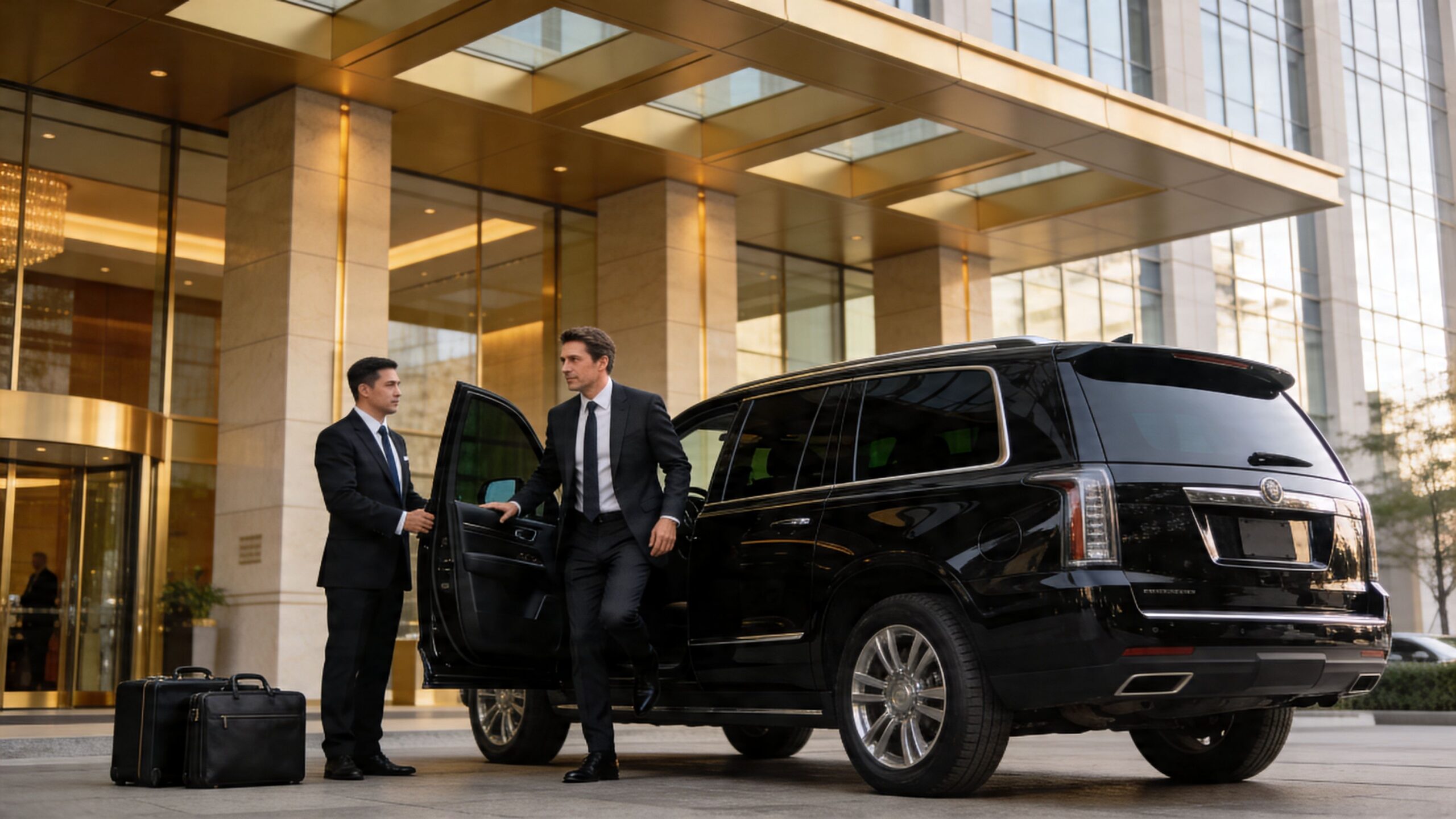
For corporate travel managers, black car service's core value isn’t “luxury” as a marketing word. It’s repeatable execution. The executive is picked up in the right vehicle, the route is monitored, and the arrival standard stays consistent across trips.
Where professional service earns its keep
In San Diego, traffic planning has become more important for business itineraries. With I-5 corridor construction causing average travel delays of 22% since Q2 2025, a black car service's traffic mitigation strategies and on-time guarantees are critical for corporate clients who cannot afford missed meetings or events, according to this cruise transportation and traffic mitigation page.
That same discipline applies to other events:
- Roadshows and executive meetings: punctual arrivals, clean presentation, minimal friction.
- Weddings and rehearsal events: group coordination, luggage or garment transport, and clear dispatch communication.
- Conference movements: airport arrivals, hotel transfers, and scheduled departures that need one accountable transportation partner.
Group events need more than a nice vehicle
Special events often fail at the transition points. Guests leave hotels at different times, one vehicle gets overfilled, and nobody is fully in charge of the loading sequence. A professional operator prevents that by assigning the right vehicle classes and coordinating the movement around the event schedule.
Corporate teams usually notice the benefit in reduced chaos. Wedding parties notice it in mood. Everyone notices it when the trip starts on time and nobody is negotiating seats or bag placement at the curb.
A polished black car operation works because it combines three things that don’t often show up together in casual transportation: scheduling discipline, fleet depth, and human accountability.
Your Booking Checklist for a Perfect Departure
Most cruise transfer problems are preventable. They happen because details were assumed instead of confirmed.
Use this checklist before you book:
- Confirm the exact passenger count: Include children and anyone joining from a different pickup point.
- List the exact luggage load: Count checked bags, carry-ons, garment bags, strollers, and bulky extras.
- Provide flight details if arriving by air: That allows the service to align the pickup with your arrival.
- Give the cruise line and ship information: It helps dispatch confirm the correct terminal logistics.
- Ask about wait time and delay handling: You want a clear answer before travel day.
- Clarify pickup style: Curbside is faster for some travelers. Meet-and-greet is better for others.
- Check amenities in advance: If you need child seats or Wi-Fi, request them at booking.
- Review the booking steps carefully: A practical car service reservation checklist helps catch the details people usually miss.
The last thing to verify
Ask what happens if timing goes wrong on the operator’s side. A serious provider should be comfortable discussing punctuality standards and backup coverage.
That answer tells you a lot. Companies that plan well tend to answer quickly and specifically. Companies that don’t usually answer with vague reassurance.
Frequently Asked Questions
Do I need a child seat for a cruise terminal transfer?
If you’re traveling with young children, request the child seat when you book. Don’t assume one will be available last minute. The main issue isn’t just safety. It’s making sure the assigned vehicle is prepared for your family’s setup before arrival.
Can a black car service handle a large family with lots of luggage?
Yes, but only if the vehicle is sized correctly in advance. For cruise travel, luggage volume matters as much as passenger count. Families and multi-cabin groups are often better served by an SUV or Sprinter than by trying to maximize a smaller vehicle.
Is meet-and-greet worth it at the airport?
For many cruise travelers, yes. It’s especially useful after a long flight, with children, or when the group has multiple bags. Meet-and-greet reduces airport confusion and makes the handoff cleaner.
Can I request an extra stop before the port?
Usually yes, but ask in advance. A quick hotel stop, grocery stop, or passenger pickup changes timing and sometimes vehicle planning. It should be built into the reservation, not added casually during the ride.
What if traffic gets worse than expected?
That’s exactly why professional routing matters. A serious black car operator plans buffer time, monitors conditions live, and adjusts before delays become critical. For a cruise departure, that planning is part of the service, not an upgrade.
If you want a transfer that’s built around timing, luggage realities, and polished execution, Rides On Time Transportation is a strong choice for San Diego cruise terminal service, airport transfers, executive travel, and group transportation across Southern California.